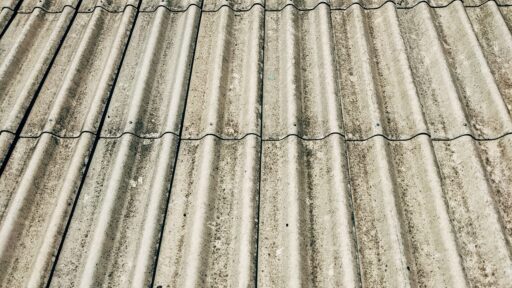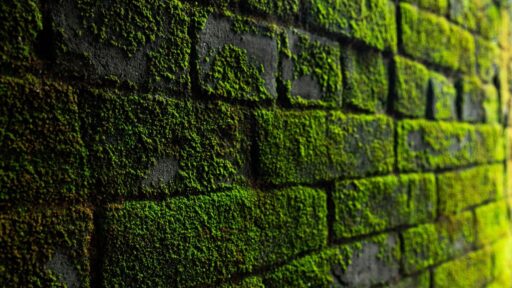

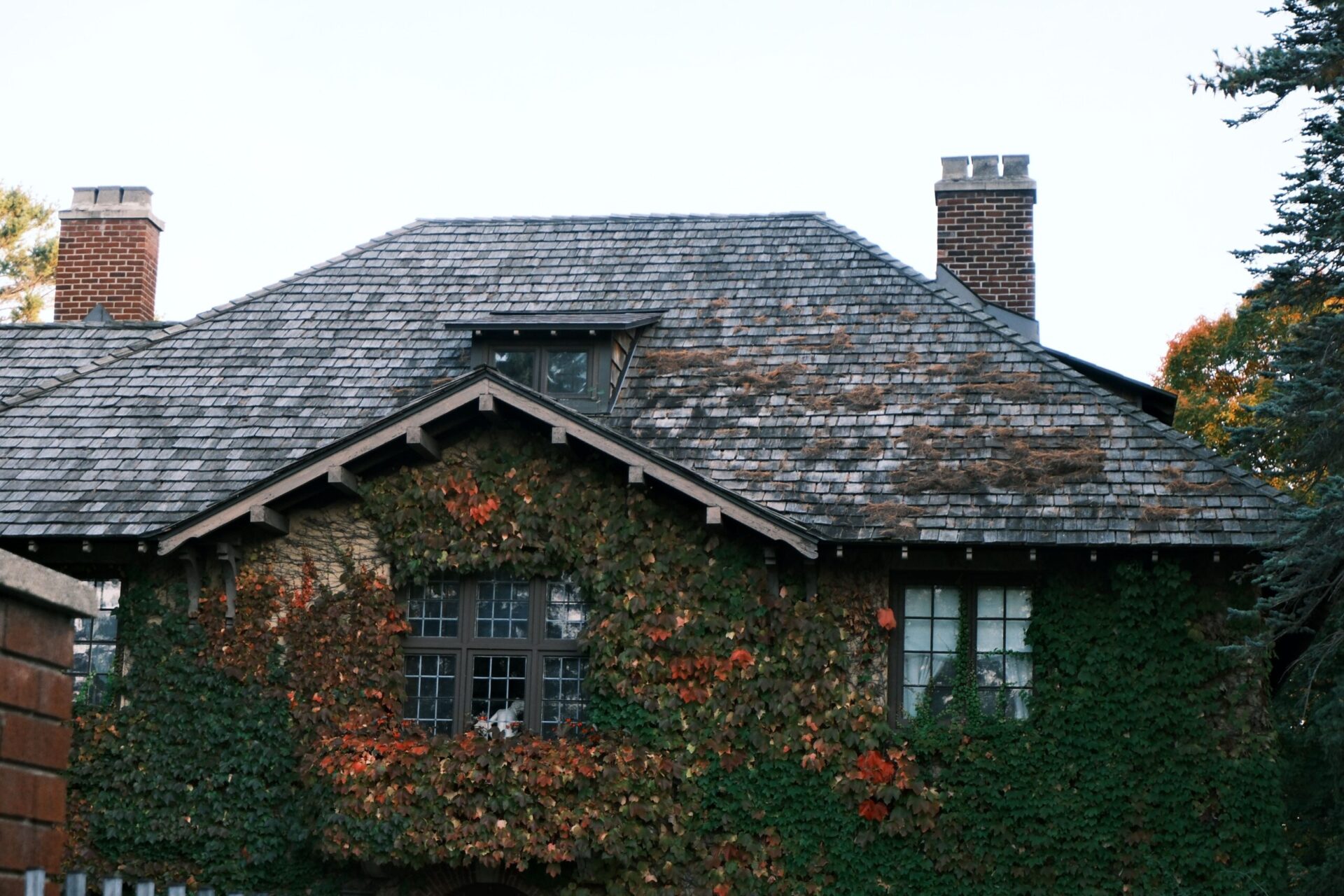
Most roof and facade cleaning jobs are ordered at the moment the problem is most visible. In northern and western Europe, that is often the end of winter: the moss is swollen with water and bright green, the algae have spread during the damp months, and the days are long enough for the facade to catch the eye on the way home from work. It is rarely the best time to remove moss from a roof, or to clean a facade. So when to clean your roof? The rest of this article answers that.
The timing of a cleaning job depends on four independent constraints: the biology of the organisms to be treated, the chemistry of the product applied, the weather needed for flying and for the treatment to work, and the protection of species that nest in buildings. These constraints do not all point to the same period, and they change from one end of Europe to the other. This article reviews them, then proposes a calendar for each broad climate zone.
Biology: treating active organisms
Mosses, lichens and many aerial algae are said to be poikilohydric: they do not regulate their water content, they equilibrate with ambient humidity. When dry, they go dormant, with an almost halted metabolism and membranes reorganised to resist desiccation. When damp, they resume activity within a few minutes to a few hours.
This property has a direct consequence for the effectiveness of biocides. A product that acts on cell membranes, such as quaternary ammonium compounds (“quats”), is much more effective on hydrated, active tissue than on desiccated tissue. Our article on facade moss removal details this mechanism. Treating a roof in the middle of a dry summer, when the moss is grey and brittle, amounts to treating a dormant organism that absorbs the product poorly.
Conversely, treating in midwinter, on waterlogged tissue, poses another problem: the product is diluted by the water already present, and frequent rain washes it off before it has acted.
The ideal biological window therefore corresponds to periods when the organisms are damp and active without being saturated, and when a few dry days follow application. In much of temperate Europe, that means spring and early autumn.
Chemistry: temperature, rain and contact time
Minimum temperature
Most technical data sheets for moss removal products set a minimum application temperature, often in the order of 5 °C, sometimes higher. Below that, biological activity slows, absorption decreases and the product may freeze on the surface. Frost in the days following application should also be avoided, as it locks the water in the substrate and interrupts the product’s action.
Maximum temperature and direct sun
At the other extreme, strong sun and high temperatures dry the solution within minutes on a dark roof. The contact time becomes too short, the product concentrates as it dries and may leave marks, and some active substances degrade under UV. In summer, applications are made early in the morning or late in the day, and preferably on shaded roof slopes.
The rain-free window
Manufacturers generally recommend a rain-free period after application, ranging from a few hours to one or two days depending on the product. Rain that comes too early dilutes and washes off the product, reduces its effectiveness and increases discharge into the networks. Our article on runoff water explains why this early wash-off is also an environmental issue.
Water-repellent treatments
If a water repellent is to follow the cleaning, the constraint is even stricter: most require a dry or nearly dry substrate to penetrate, which means several days without rain after cleaning. Technical data sheets state this explicitly, such as that of the water repellent SCALPFUGE 35, which requires a clean, dry and sound substrate before application. Our article on water-repellent and anti-moss treatments details why same-day application on a wet substrate is a warning sign.
Flying weather: wind above all
A cleaning drone is more sensitive to the weather than a MEWP or scaffolding. Three parameters count.
Wind. It destabilises the aircraft near surfaces and, above all, carries away fine droplets. Common operational limits are around 8–10 m/s, but the relevant limit for drift is often lower. And it is the wind at working height that counts, not the wind at the weather station: at building corners and roof verges, it can be markedly stronger than at ground level.
Rain. It generally rules out flying and compromises application.
Fog and low visibility. They limit the direct visual line of sight required for most cleaning operations.
Climate data from Météo-France (in French), the French national meteorological service, make it possible to estimate, for a nearby station, the number of days of strong wind and precipitation per month, and therefore the likelihood of finding a usable window. In exposed coastal regions, autumn and winter offer few flying days. The drone’s advantage, noted in our comparison of access methods, is that postponement costs almost nothing, unlike hired scaffolding standing idle until the rain stops.
Wildlife: the constraint nobody budgets for
Nesting birds
Buildings shelter many protected bird species. Swifts nest under tiles and in facade cavities, swallows and martins build their nests under roof overhangs and in window corners, house sparrows settle under tiles and in holes in masonry. In France, Article L411-1 of the French Environmental Code (in French) prohibits the destruction, alteration or degradation of the breeding sites of these protected species, as well as their intentional disturbance. At European level, the Birds Directive underpins this protection.
The Office français de la biodiversité, France’s public biodiversity agency, has published reminders on the regulations covering swallow nests (in French), and the LPO, the French bird protection league, details the legal protection of swallows and swifts. Swallow nests are protected even outside the period when the birds are present, since they often return to the same nest.
A drone spraying biocide a few metres from an occupied nest, with the noise and blast of the rotors, raises a question of disturbance that the company cannot ignore. Cleaning a facade that shelters active nests must be scheduled outside the nesting period, generally from March–April to August–September depending on species and region, and the nests themselves must not be touched.
Bats
Bats use attics, gaps under tiles, open masonry joints and roller-shutter boxes. All species are protected in Europe. They are particularly vulnerable during the birthing period, in early summer, and during hibernation. Our article on cleaning listed buildings returns to these constraints, which are common on old buildings.
The calendar by climate zone
The recommendations below are indicative. They combine biological, chemical, meteorological and wildlife constraints, and must be adjusted according to the building’s exposure, the product used and the presence of protected species.
| Climate zone | Main window | Secondary window | To avoid |
|---|---|---|---|
| Oceanic north-west (Brittany, Normandy, Ireland, Great Britain, Benelux) | April–May, before full nesting, in dry weather | September–October, between two depressions | November–February: frequent rain, wind |
| Continental interior (eastern France, Germany, Switzerland, Austria) | September–mid-October | April–May, outside late frosts | December–February: frost; July–August: drought, heat |
| Mediterranean south (Provence, Occitanie, Spain, Italy) | October–November, after the first rains | February–March | June–August: dormant organisms, rapid evaporation |
| Mountains and high altitude | Late May–June, then September | Depending on snow cover | November–April: frost, snow |
Two remarks are called for.
The south reverses the northern calendar. In Mediterranean Europe, biological growth is an autumn and winter phenomenon, and summer is the dormant season. Treating a Provençal roof in July amounts to treating inactive tissue, with a product that dries within minutes.
Nesting shortens the spring windows. In every zone, spring is both a good biological period and the start of nesting. On a building that shelters swifts or swallows, the spring window shrinks to a few weeks before their arrival, or even disappears, and autumn becomes the only option.
Orientation changes the calendar within a single building
On a single building, not all roof slopes live at the same pace. A north-facing slope stays damp for hours after dawn and supports active colonisation almost all year round in north-western Europe. A south-facing slope dries quickly, and its moss goes dormant from the first warm weeks. A west facade takes driving rain, an east facade gets the morning sun, which dries the dew earlier.
This heterogeneity has two practical consequences. First, the ideal window is not the same for each slope: in late spring, the north slope is still in good condition when the south slope is already too dry. Second, a well-timed job can start with the slopes most exposed to the sun early in the morning, before they heat up, and finish with the shaded slopes. A careful company organises its flight around the path of the sun rather than the convenience of the order of work.
And if you cannot wait?
Sometimes a cleaning job cannot be postponed: a property sale, an end-of-tenancy inspection, a works handover, a gutter overflowing because it is blocked by moss. In these cases, the aim is no longer maximum treatment effectiveness but an acceptable result by a given date.
Out of season, three adjustments limit the damage. Favour gentle mechanical removal of the thickest moss cushions, which gives an immediately visible result whatever the season. Choose the day carefully, within a dry window of a few days, however short. And postpone the residual treatment to the following season rather than applying it in poor conditions where it will be washed off before it has acted. A two-stage job costs a little more, but it avoids paying for an ineffective treatment.
Planning in practice
Book early, confirm late. Drone cleaning companies are in heavy demand in spring and early autumn. Booking several weeks ahead and agreeing to confirm a few days before, depending on the wind and rain forecast, is the most effective practice.
Provide for postponement without penalty. The contract must specify what happens if the weather prevents the work. Postponement free of charge is the norm, and it should be provided for in writing.
Align the copropriété vote with the season. In a building under copropriété (the French system of co-ownership of a building), the decision goes through the general meeting, whose agenda is set weeks in advance. Voting in spring for work in autumn, or in autumn for the following spring, aligns the decision calendar with the work calendar. Our article on facade renovation in a copropriété details this organisation.
Check for wildlife before booking. A simple visual check for nests under roof overhangs and signs of bats, or the opinion of a local nature conservation association, avoids scheduling a job in the middle of the breeding season.
Measure on site. On the day of the work, wind at working height is checked with an anemometer, and substrate temperature with an infrared thermometer. A pocket device is enough, such as those in the Kestrel range for wind and humidity.
Best time to remove moss from a roof: the key points
The best time to clean a roof or facade is not when the moss is most visible. It is when the organisms are active, when the product can act for several days without being washed off, when the wind allows precise flight without drift, and when no birds or bats are breeding. In most of temperate Europe, that means early autumn and, with reservations, spring. In the Mediterranean south, it is autumn and late winter.
A company that offers to come on any date, without asking about exposure, the product or the presence of nests, is not selling you an optimised schedule but availability. Ask it why the proposed date is the right one.