
On a cleaning job, a great deal is said about what reaches the wall and very little about what leaves it. Yet every litre sprayed ends up somewhere: in a gutter, an inspection chamber, a lawn, a flower bed, a rainwater tank, a ditch. And that litre is not rainwater. It contains the product applied, the detached biomass, particles torn from the substrate, and sometimes metals leached from copper or zinc roofing. Facade cleaning runoff water is the part of the job that rarely appears on the quote.
Runoff is not only an environmental question. It is a legal one, because discharging contaminated water into a sewer network or the natural environment is regulated. It is a practical one, because this is often where complaints from neighbours begin. And it is a technical one, because the cleaning method radically changes the volume and nature of what flows away. This article follows the path of the water, from the wall to its outfall.
How much water does facade cleaning really produce?
The orders of magnitude vary enormously with the method, and that is the first point to understand.
High-pressure cleaning uses a lot of water. A professional pressure washer commonly delivers 10 to 20 litres per minute. On a house facade treated in a single day, that represents several thousand litres, most of which runs off, carrying away dirt and particles from the substrate.
Low-pressure chemical application uses far less. The technical data sheets for treatment products generally state consumption in the order of a few tenths of a litre of diluted solution per square metre, depending on the porosity of the substrate. On a 150 m² roof, that represents a few dozen to a hundred litres of solution, part of which is absorbed by the substrate.
Rinsing, when it follows application, adds an intermediate volume.
The drone, confined by the physics of flight to low-pressure application, therefore produces little water on the day of the work. That is a real advantage. But this observation needs completing: a residual biocide is designed to stay on the substrate and dissolve gradually. The first rains after treatment wash off a significant fraction of the product. Work by the Swiss institute Eawag on facade biocides has shown that this leaching is concentrated in the first rainfall events. The real discharge therefore takes place after the team has left, and that is what job plans most often forget.
What cleaning water contains
The products themselves
Biocides based on quaternary ammonium compounds (“quats”), the most widespread for moss removal, are classified as very toxic to aquatic organisms. They adsorb strongly onto organic matter and mineral particles, which limits their mobility in soils, but not in water flowing directly towards a stream. Sodium hypochlorite, used as an oxidant, is also toxic to aquatic life, even though it breaks down faster. Their safety data sheets, drawn up under the CLP Regulation, state these hazards in their H400 or H410 statements.
Biomass and particles
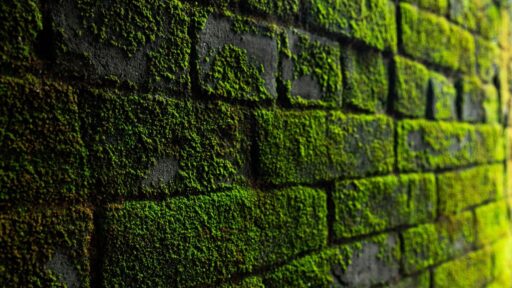
The detached mosses, lichens and biofilms form an organic load. Particles torn from the substrate, render fines, tile grains, paint pigments, end up in gutters and inspection chambers. On a substrate containing asbestos, these particles may contain fibres, which changes everything, as our article on asbestos on roofs explains.
Metals
Water running over copper, zinc or lead roofing or fittings picks up dissolved metals, particularly if the product applied is slightly acidic or oxidising. These metals add to the load of the discharge.
Where the water goes: following the path from wall to outfall
The separate stormwater system
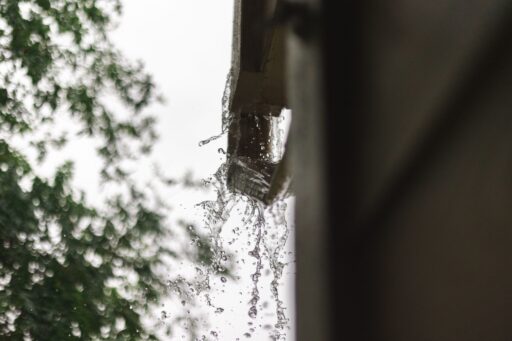
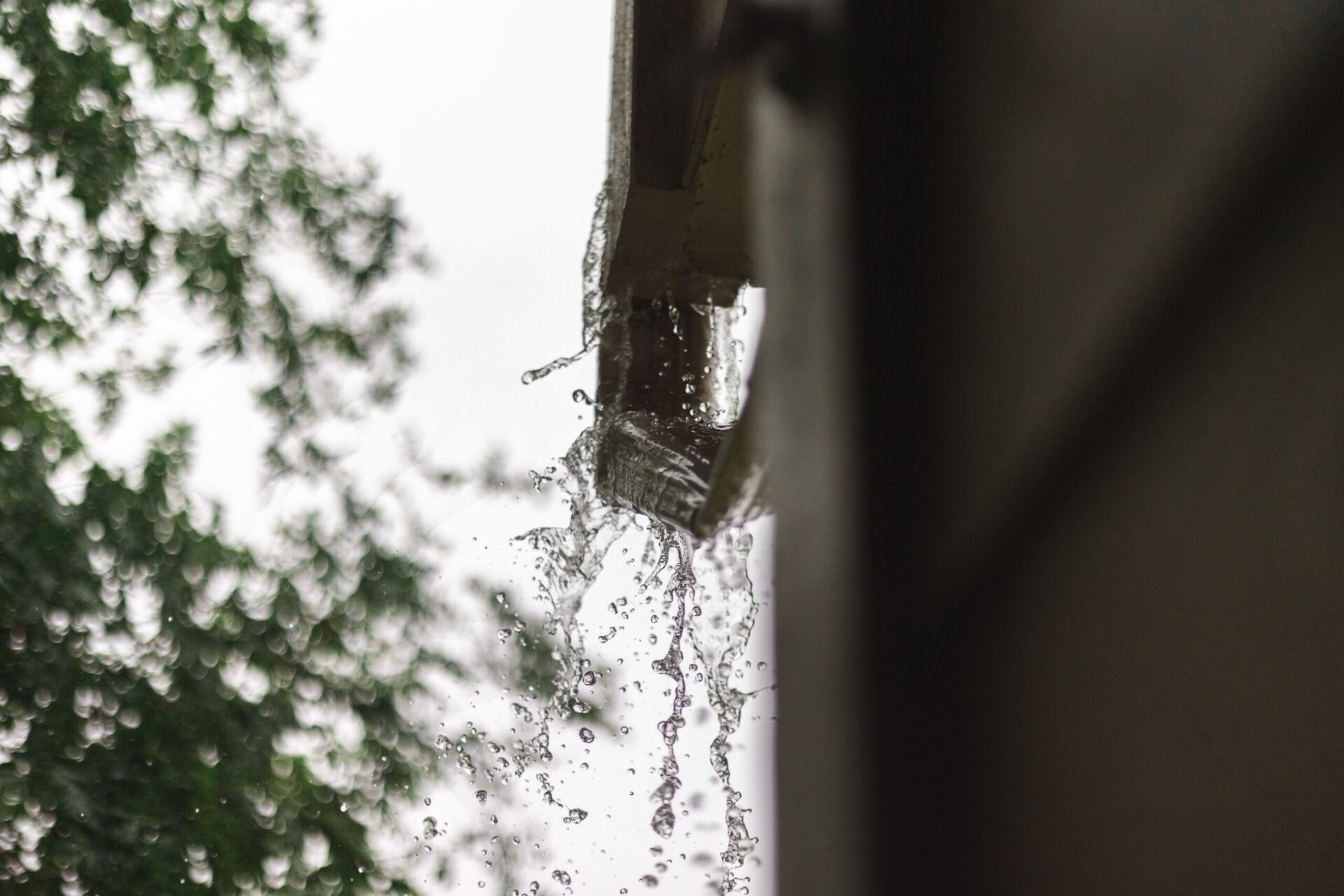
In neighbourhoods served by a separate sewer system, rainwater is collected in a network distinct from foul water. This network most often discharges its water without treatment into a ditch, a stream or a river. A downpipe connected to the stormwater system is therefore, in practice, a pipe leading to the natural environment. Pouring cleaning water loaded with biocide into this network amounts to pouring it into the watercourse.
The combined system
In older town centres, stormwater and foul water often share the same network, which ends at a wastewater treatment plant. The discharge there is less direct, but it is not unrestricted for all that. Treatment plants rely on bacterial biology that some biocides can disrupt at high concentration, and during heavy rain, storm overflows send part of the untreated water back to the natural environment.
Infiltration on the plot
Water running towards a lawn, a flower bed or a soakaway infiltrates into the soil. Plants at the foot of the walls are the first exposed, and a biocide that kills moss does not always spare plantings. A rainwater tank connected to the downpipe will collect the first wash-off: its water should not be used to water a vegetable garden in the following weeks.
Runoff water: what the regulations say
In France, several texts govern these discharges, and it is better to know they exist than to discover them after a complaint.
The French Public Health Code makes any discharge of non-domestic wastewater into the public collection network subject to authorisation from the local authority (in French) that owns the network. Cleaning water from a professional job is not domestic wastewater. Local authorities’ sanitation regulations, such as the Paris sanitation regulations (in French), specify what may be discharged into each type of network and generally prohibit discharges of harmful substances into the stormwater system.
The French Environmental Code penalises throwing or allowing to flow into water any substances whose action causes harmful effects on health, fauna or flora. Article L216-6 (in French) provides for significant criminal penalties, and liability may fall on the company as well as, depending on the circumstances, on the client.
The European framework sets the objectives of good status for bodies of water under the Water Framework Directive, and biocidal product authorisations issued under Regulation (EU) No 528/2012 may include conditions of use designed to protect aquatic environments, such as a ban on application before forecast rain or distances to be respected.
This is not to say that every roof cleaning is an offence. It is a reminder that an uncontrolled discharge into the stormwater system is not trivial, and that the job documentation must show that the question has been dealt with.
Controlling runoff: simple, effective measures
The good news is that most of the useful measures are inexpensive, provided they are planned before the work.
Map the outfalls. Before the job, locate each downpipe and find out where it ends: stormwater system, combined system, soakaway, tank, soil. This map takes half an hour and determines every other decision.
Block or divert the downpipes. During application and, for residual biocides, until the first significant rainfall, downpipes connected to the stormwater system can be disconnected and directed to a retention tray, or blocked at the inspection chamber with a suitable stopper. The collected water is then disposed of through the route indicated by the safety data sheet.
Protect road gullies. A mat or sealing plate placed over the gully gratings in the runoff zone prevents any run-off from going straight into the stormwater system.
Disconnect rainwater tanks. Any rainwater harvesting tank must be isolated during the work and the first rainfall events.
Protect vegetation. Sheeting over flower beds, watering plantings beforehand to limit absorption, rinsing foliage hit by drift.
Choose the moment. Applying a biocide just before heavy rain maximises immediate wash-off into the network and minimises the effectiveness of the treatment. A dry window of a few days after application is generally recommended by manufacturers. Our article on the best season for cleaning details these windows by climate.
Dose correctly. Overdosing does not buy durability, as our article on facade moss removal explains. Beyond the effective threshold, the extra product mostly ends up in the runoff.
Situations that call for heightened vigilance
Some environments turn ordinary runoff into a serious risk.
Drinking water catchments. Catchment protection zones are subject to requirements set by prefectoral order (an order issued by the préfet, the State’s representative in the département), which may restrict the use of certain products. A building located in a close protection zone justifies checking beforehand with the mairie (the local town hall) or the agence régionale de santé (ARS, the regional health agency).
Private wells and boreholes. A house supplied by a well, or whose garden contains a borehole, must not let cleaning water infiltrate near the installation.
Watercourses and wetlands. A building beside a river, pond or marsh often discharges its stormwater directly into the environment, with no intermediate network. Aquatic organisms are exposed there without any prior dilution.
Ornamental ponds and swimming pools. A fish pond beneath a gutter or in the drift zone can be devastated by a few litres of biocide. A neighbouring swimming pool receiving spray mist may need to be rebalanced.
Vegetable gardens and beehives. Plants intended for consumption and neighbouring apiaries deserve particular protection and the owners should be informed.
In these cases, diverting the downpipes during the first rainfall events is no longer a precaution but a condition of the job, and choosing a less persistent product may be justified even at the cost of a shorter effect.
Drone cleaning and runoff: advantages and pitfalls
The drone has a structural advantage: it applies small volumes, without high pressure, and therefore without the torrent of water and particles of stripping. On the sole criterion of the volume discharged on the day of the job, it is markedly more economical than high-pressure cleaning.
It also has two pitfalls of its own.
Drift. Aerial spraying produces a fraction of fine droplets that the wind and the rotor downwash can carry several metres, or even further. These droplets settle on neighbouring roofs, cars, gardens, and sometimes directly on a pond or a ditch. Controlling droplet size and a wind limit measured at working height are part of the risk assessment required by the drone regulations.
The illusion of a clean job. Because the day of the work produces almost no water, it is forgotten that the residual treatment will be washed off later. Without disconnecting the downpipes during the first rains, the discharge simply takes place later.
Order of magnitude of water control costs
Expressed in the reference unit used in our articles, one drone cleaning pass on a reference house, the cost of the control measures is modest.
| Measure | Indicative cost (× reference unit) | Comment |
|---|---|---|
| Mapping the outfalls | Included in the site visit | Essential |
| Temporary blocking of inspection chambers and gullies | 0.02–0.05× | Reusable equipment |
| Diverting downpipes to a retention tray | 0.05–0.15× | Depending on the number of downpipes |
| Removal and disposal of collected water | 0.05–0.2× | Depending on volume and disposal route |
Compared with the legal exposure and the complaints avoided, these amounts are small. A quote that makes no mention of them does not necessarily mean that the company is neglecting the question, but it is a good reason to ask it.
Runoff water: questions to ask before the job
Before approving a facade or roof cleaning job, ask the company these five questions:
- Where does each downpipe on the building end up, and is the system separate or combined?
- Which product will be applied, in what quantity, and what environmental precautions does the safety data sheet require?
- Will the downpipes and gullies be blocked or diverted, and until when?
- How will any collected water be disposed of?
- What wind limit and what droplet size are planned to contain drift?
A well-conducted cleaning job is not judged solely by the look of the wall three months later. It is also judged by the fact that nobody downstream noticed anything. For an owner as for the syndic (the managing agent of a French co-owned building) of a copropriété (the French system of co-ownership of a building), including these questions in the specification costs nothing and avoids most of the environmental disputes linked to facade maintenance.