
Finishing treatments are offered at the very moment when the customer is least able to assess them. The roof or facade has just been cleaned and has never looked better, so the idea of ‘protecting’ that result seems reasonable. Yet any benefit from the treatment only becomes visible after several years, and by then there is no longer any point of comparison. A water-repellent treatment is worth its price only in specific cases.
Two very different products are often sold together under the same name. A residual biocide slows recolonisation by algae, mosses and lichens. A masonry water repellent changes the way the material absorbs and releases water. The first is designed to wear out. The second is designed to stay, and its effect, beneficial or harmful, depends on the material and its moisture history.
On price, the treatment generally adds 0.3–0.6× the cost of the cleaning itself. That is too large a share to accept by default, but it can be justified. Three questions, which any customer can ask anywhere in Europe, make it possible to tell the justified cases from a simple upsell.
Masonry water repellent and anti-moss biocide: what these two products actually do
Residual biocides: a reservoir designed to be washed out
A residual anti-moss or anti-algae treatment deposits an active substance on the surface and in the superficial pores. Spores and fragments that land afterwards meet a toxic environment before they can establish themselves. For this to work, the substance must be at least partly water-soluble, because cells can only take it up in solution.
That solubility also explains why the treatment is temporary. Every rain event dissolves part of the reservoir and carries it off the surface. Field and laboratory research on biocides contained in facade renders and paints, carried out in particular by the Swiss water research institute Eawag and its partners, has repeatedly shown that leaching is front-loaded. Concentrations in runoff peak during the first rains after application, then decline roughly exponentially. The duration of protection therefore depends on cumulative rainfall and exposure, not on the calendar.
Water repellents: lining the pores rather than blocking them
Impregnating water repellents for mineral substrates are mostly based on silanes or siloxanes. These small organosilicon molecules penetrate the pore network, then hydrolyse and condense: they bond to the mineral surfaces and form a thin water-repelling polysiloxane lining on the pore walls. The pores remain open. Liquid water is held back by surface tension, because the contact angle on the treated wall exceeds 90°, which reverses capillary suction. Water vapour, on the other hand, can still diffuse.
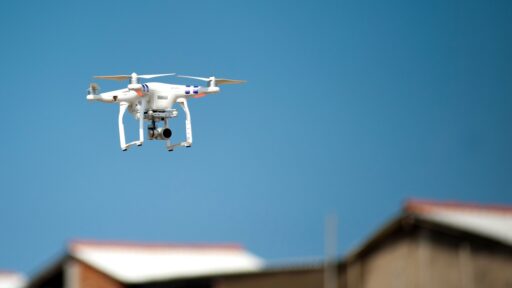
That is the whole difference from a film-forming coating. A properly applied impregnation (for example a colourless, microporous, water-based water repellent such as SCALPFUGE 35, which its manufacturer presents as suitable for drone spraying) can sharply reduce capillary absorption while barely changing vapour permeability. A film-forming product, such as an acrylic coat or any other coating that closes the surface, can instead block vapour and trap moisture behind it.
For concrete, the EN 1504-2 standard treats hydrophobic impregnation as a separate category of surface protection and sets performance requirements, including penetration depth, reduction in water absorption and resistance to alkalis. For historic and ordinary masonry, conservation bodies such as the German association for building preservation (WTA) publish recommendations on when a water-repellent treatment is appropriate.
Molecule size determines where each type can be used. Monomeric silanes are small enough to penetrate dense concrete. Oligomeric siloxanes are better suited to more porous bricks, renders and stones. Penetration depth, generally a few millimetres, governs how long the treatment resists erosion and UV at the surface.
Does a water repellent prevent algae?
Only partly, and not always. Algae and mosses need liquid water, so reducing absorption can slow their growth on absorbent substrates such as porous brick, concrete tiles or aged render. On facades, it is more complicated. Building physics research on external wall insulation (EWI), notably at Fraunhofer IBP, has looked at whether water-repellent or absorbent renders dry faster after dew and rain. It has shown that a strongly water-repellent surface can hold condensation as droplets. Since these droplets feed algae growth, the effect can be neutral or even negative. Treat any promise that a water repellent will ‘prevent algae’ as unproven for your substrate.
Question 1: is the anti-moss product or water repellent authorised for this use in your country?
In Europe, biocidal products are authorised for specific uses, not in general. The authorisation generally specifies the type of surface, whether the product is intended for professionals or the general public, the application method, the dose and the conditions of use. A product authorised for brush application on a patio is not necessarily authorised for professional spraying on a roof, and spraying from an aircraft is a further step again. Authorisations are also granted country by country (in French).
In practice, ask the company for the product documentation:
- the label, which carries the authorisation details and the authorised uses,
- the safety data sheet,
- the technical data sheet, which gives the dilution rate and the list of compatible substrates.
Then check two points: the intended use is indeed among the authorised uses, and your substrate is among the compatible substrates.
Water repellents that claim no biocidal action do not fall under biocide authorisation. For them, the question becomes: is the product suitable for this substrate? The technical data sheet should state this explicitly. A company that cannot or will not provide these documents has already answered the question.
Drone spraying also generally requires an operational authorisation issued by the national civil aviation authority (the DGAC, France’s civil aviation authority). It is separate from the product authorisation, and both must be in place.
Question 2: where does the runoff go after roof or facade moss removal?
Since residual biocides are designed to be washed out, the key environmental question is where that leachate ends up. Follow the path of the water from the roof or wall:
- Gutters and downpipes to a stormwater system. In separate sewer systems, rainwater is often discharged untreated into a stream or river. Eawag’s work has found facade biocides in urban stormwater at concentrations which, during the first flush, can exceed ecotoxicological thresholds for aquatic organisms.
- Rainwater harvesting. If the downpipe feeds a tank used for watering, toilet flushing or laundry, the first rain events will carry biocide into it. Some biocides also affect plant growth.
- Soakaways, ponds and gardens. Runoff towards flower beds or ornamental ponds brings the substance into direct contact with plants and aquatic wildlife.
- Drift. Any spraying, whether by drone or by lance, deposits a fraction of the product off target. Neighbours’ cars, plantings and open windows are all exposed.
Some mitigation measures are simple to put in place. Disconnect or divert downpipes that feed tanks or ponds during the first significant rain events. Avoid applying the product just before heavy rain. Use coarse droplets to limit drift. None of these measures works if nobody knows where the water goes.
Water repellents raise a different problem: overspray on glass or polished surfaces can leave a haze that is hard to remove, and solvent-based products emit volatile organic compounds.
Question 3: how long does a water-repellent or anti-moss treatment really last?
Durability depends more on exposure than on the product, so the relevant unit is the climate zone. The ranges below are indicative values, drawn from field experience and published research on biocide leaching and the ageing of impregnations. They are not guarantees, and some sites may fall outside them.
| Climate zone | Residual anti-moss/anti-algae treatment | Impregnating water repellent |
|---|---|---|
| Oceanic north-west (Ireland, Great Britain, Benelux, French Atlantic coast, Denmark) | 1–3 years | 5–8 years |
| Continental interior (Germany, Austria, Czechia, Poland, northern Italy) | 2–4 years | 6–10 years |
| Mediterranean south (Iberian Peninsula, southern Italy, Greece) | 3–5 years | 8–12 years |
| Exposed coastal sites, at any latitude | 1–2 years | 4–7 years |
For biocides, the more it rains, the faster the leaching: that is why the oceanic zone shows the shortest duration. The Mediterranean figure should be read with caution. Lower rainfall preserves the reservoir, but the organisms there are different, mainly cyanobacteria and lichens on stone, and their recolonisation is slow in any case, so the marginal benefit of the treatment may be small. For water repellents, UV and erosion degrade the outer millimetres. Deeper penetration therefore extends service life in all zones. On exposed coasts, salt and driving rain shorten both.
Turning durability into a decision
Durability only means something relative to how long a cleaned surface stays acceptable without treatment. A simple break-even calculation helps decide. Let:
- I = the interval between two cleanings without treatment, in years,
- t = the cost of the treatment expressed as a multiple of the cost of cleaning (0.3–0.6),
- Δ = the number of years by which the treatment extends that interval.
The treatment pays for itself when Δ > t × I. With a five-year interval and a treatment charged at 0.5×, the treatment must push back the next cleaning by at least 2.5 years.
Compare this result with the durability table. A residual biocide lasting 1–3 years in the oceanic north-west delays the start of recolonisation by roughly its own service life. That is only enough if the treatment sits at the low end of the price range, or if the untreated interval is short. This is not proof that a treatment never pays off, only the calculation to do before accepting it.
When a water-repellent treatment damages the facade or roof: failure modes
Water repellents can damage the building itself, through mechanisms well documented in the conservation literature.
- Salt crystallisation behind the treated zone. If the masonry contains soluble salts, from de-icing salts, marine exposure, rising damp or old cement repairs, the water repellent moves the evaporation front from the surface to the boundary of the treated layer. The salts then crystallise a few millimetres inside the material instead of being deposited on the surface, and the resulting pressure can burst the treated skin. This is the most common and most serious failure.
- Water entering by another route. A water repellent does not bridge cracks wider than a few tenths of a millimetre, open joints or failed flashings. Water that gets in through these routes, or that rises from the ground, now dries more slowly, because the surface slows the transport of liquid water outwards. The wall can end up wetter than before.
- Frost damage. On clay tiles and soft bricks, trapped moisture and the shift of the wet front can worsen frost damage. Some tile manufacturers advise against applying coatings or impregnations after installation and state that doing so may affect the product warranty. Check the manufacturer’s recommendations for the product in place.
- Irreversibility on historic buildings. Silane- and siloxane-based impregnations are practically impossible to remove. European heritage bodies generally advise against water repellents on historic lime masonry, except as a last resort, as a specialist intervention tested beforehand.
- Interference with a system designed as such. EWI systems use renders and finishes formulated as a system, which often already contain biocides and water-repellent additives. Adding an extra coat without the agreement of the system holder can change its moisture behaviour.
Application errors specific to drone work
Two errors are specific to drone application, or made worse by it:
- Applying a water repellent to a wet substrate. Cleaning soaks the surface. Most impregnations require a dry or nearly dry substrate to penetrate, so applying a water repellent the same day on a freshly washed surface is a warning sign, unless the technical data sheet explicitly allows application on a damp substrate.
- Uneven dosing. Impregnating water repellents are generally applied to saturation, often in two coats ‘wet on wet’, at the rate given in the technical data sheet. Low-flow spraying from a moving aircraft makes that rate harder to achieve evenly, especially on vertical surfaces where the excess runs off before it has penetrated.
There is a simple check. The RILEM tube test, also called the Karsten tube, measures water absorption over a small area. Measurements before treatment and then a few weeks afterwards show whether the impregnation has been effective. Failing that, a water drop test on several areas should at the very least show beading and no absorption.
When to refuse treatment after roof or facade cleaning
Refuse the treatment, or at least postpone it, in any of the following cases:
- The company cannot provide documentation showing that the product is authorised for this use in your country and suitable for your substrate.
- Nobody can say where the runoff goes, or it feeds a rainwater tank, a pond or a sensitive watercourse that cannot be diverted.
- The masonry shows salt efflorescence, rising damp, open cracks or failed joints. Deal with the source of moisture first.
- The building is in historic lime masonry or soft brick, and no conservation specialist has assessed it.
- The roof is in clay tiles and the manufacturer advises against any treatment, or the roof is nearing the end of its life.
- The facade is EWI and the system holder has not approved the product.
- You are offered a water repellent on the same day, on a surface still wet from cleaning.
- Durability in your climate zone, set against the break-even threshold Δ > t × I, does not add up.
Roof and facade cleaning: when the treatment is worth its price
In some cases, the treatment makes perfect sense:
- A residual biocide is easiest to justify when recolonisation is fast and the untreated interval short, when the runoff can be controlled and when the price is at the low end of the 0.3–0.6× range. North-facing, shaded and damp roofs, in a continental climate and with separate stormwater management, are the clearest example.
- An impregnating water repellent is easiest to justify on sound, salt-free, absorbent substrates exposed to driving rain, such as concrete, modern brick or cement-based render, where reducing capillary absorption provides protection against moisture and frost that goes beyond appearance. Its effectiveness should be checked with a before-and-after absorption test.
The treatment is neither automatically an upsell nor automatically a good investment. At 0.3–0.6× the cost of cleaning, it has to justify its price like any other work on the building.