
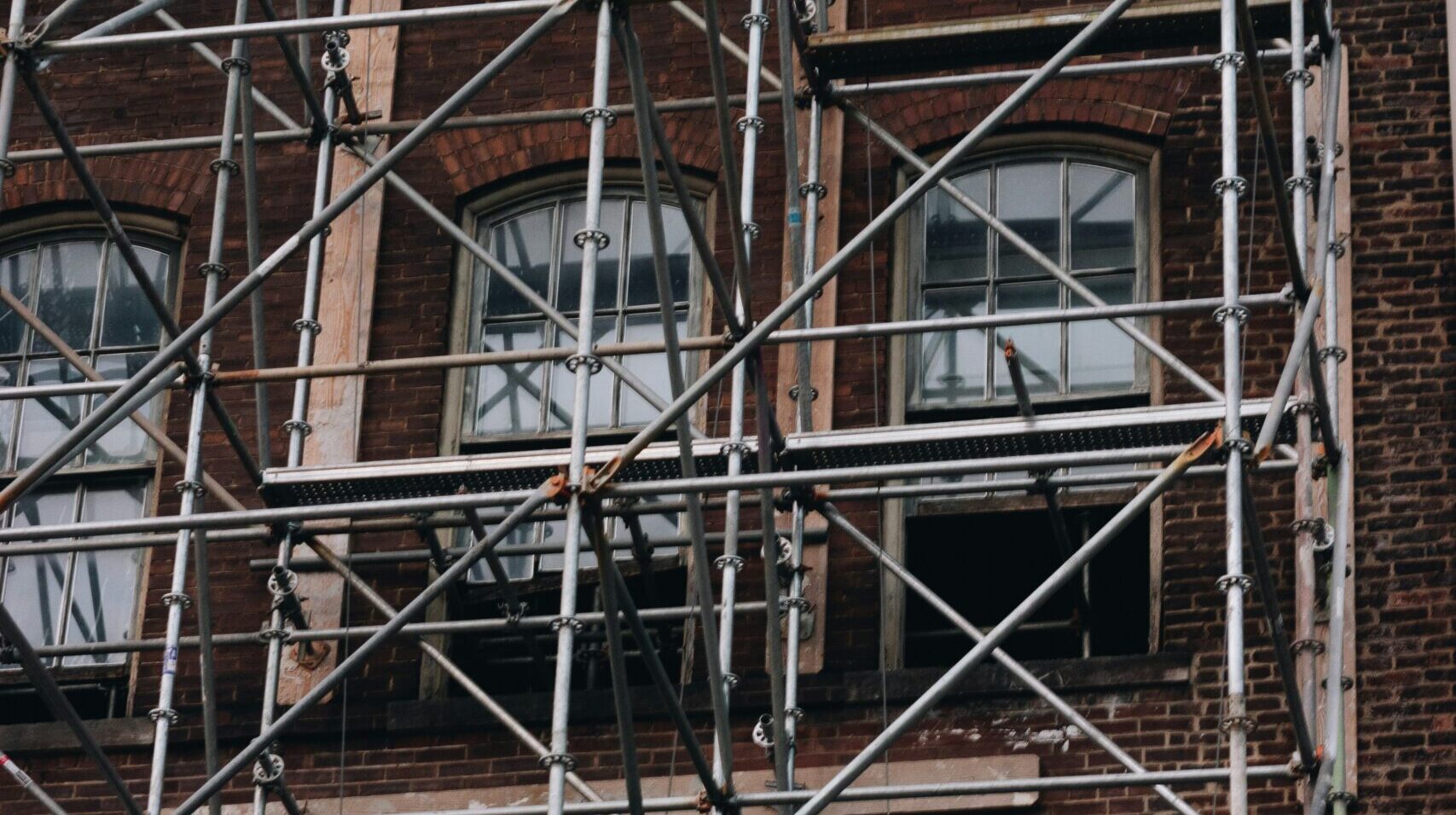
In a building with several owners, facade maintenance rarely fails for technical reasons. It fails on procedure. The quote arrives a week after the agenda for the general meeting has closed, or the vote passes but the works fund, the reserve that co-owners pay into for future building works, cannot cover the expense, or the scope is so vague that the co-owners who want to postpone the work find credible arguments. A facade that could have been cleaned gently in its third year is left as it is until its tenth. In the meantime, biological colonisation has taken hold, the render stays damp for longer each winter, and the only proposal anyone takes seriously involves scaffolding. Co-ownership facade renovation is decided in a general meeting, not on a roof.
Legal vocabulary varies from one European country to another, but the sequence of decisions does not change. All the shared-ownership regimes in the region include, in one form or another, a copropriété (the French term for co-ownership of a building, used here for all such regimes), a designated syndic (the managing agent who runs the building on the co-owners’ behalf), a vote at a general meeting, a common budget or works fund, and a maintenance plan. The names, notice periods and majority thresholds differ between countries. The logic that turns ‘the north wall is going green’ into signed-off works is the same everywhere. This article follows that sequence, details the technical content a quote needs to get through the vote, and gives the cost orders of magnitude that a syndic actually uses.
Facade cleaning: why frequency matters more than price
Slow colonisation, then fast
Algae, cyanobacteria, mosses and lichens do not grow steadily on a facade. Colonisation generally follows a latency phase, then accelerates. Spores and cells are deposited continuously, but they only settle where moisture persists: north and west facades, surfaces shaded by balconies, areas beneath window sills and copings, and the thin renders of external wall insulation (EWI) systems. On these renders, building physics research, notably the long-standing work carried out at the Fraunhofer IBP, has shown that the surface cools below the dew point on clear nights, through radiation to the sky, and then stays damp until well into the morning.
Once the biofilm has formed, it retains water and traps airborne dust, which in turn retains more moisture and feeds growth. The process then snowballs. Mosses anchor themselves with their rhizoids, and lichens penetrate the first few millimetres of porous substrates by means of their fungal hyphae. The result is not just a darker wall, but a more firmly colonised one.
What early cleaning brings
Cleaning is gentlest when the biofilm is still thin: a low-dose biocide or oxidant, low pressure, a short dwell time. Established colonisation requires stronger chemistry, longer contact or mechanical action, and each of these levers increases the risk to the substrate.
There is also a plausible durability argument. Biological colonisation keeps surfaces damper, and moisture promotes freeze-thaw damage and the degradation of paint binders; keeping facades clean could therefore lengthen repainting and repair cycles. The link is physically sound, but it has not been well quantified for common European renders: treat it as a reasonable expectation rather than a proven saving.
In practice, visible regrowth often reappears on the most exposed facades within two to four years in the oceanic north-west and the continental interior, and more slowly on sunny facades in the Mediterranean south. These are indicative ranges, to be checked against your own building’s history. They are what make a two-yearly drone cleaning cycle the relevant comparison.
Drone cleaning or scaffolding: the ratio that matters to the syndic
All figures use the same reference unit: one drone cleaning pass on a reference house, that is, a two-storey detached house, roof and facades included. The reference building is a five-storey residential block, with its eaves at about 15–18 m, assumed here to be owned by 20 co-owners. Adapt the per-co-owner amounts to your own building.
On the reference building, one drone cleaning pass generally costs 4–7× the reference unit, and a scaffold-based cleaning campaign 20–35×. The comparison syndics make in practice sets a drone pass every two years against scaffolding once a decade:
| Ten-year strategy | Total cost (× reference unit) | Per co-owner per year (20 co-owners) |
|---|---|---|
| Drone pass every two years (5 passes) | 20–35× | ~0.10–0.18× |
| Scaffold-based cleaning once a decade | 20–35× | ~0.10–0.18× |
Over a decade, the ratio is about 1:1, and this result deserves careful reading. It is not total expenditure that distinguishes the two strategies. They differ on four points:
- Condition over time. The two-yearly strategy keeps the facade almost clean for most of the decade. The once-a-decade strategy lets it deteriorate for years before restoring it.
- Cash-flow profile. Small, predictable amounts fit into a routine maintenance budget. A large one-off sum usually means an exceptional call for funds or a large draw on the works fund, and that is where votes are lost.
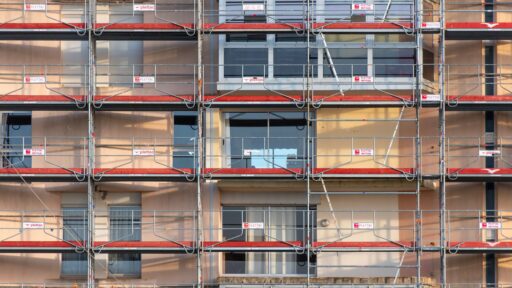
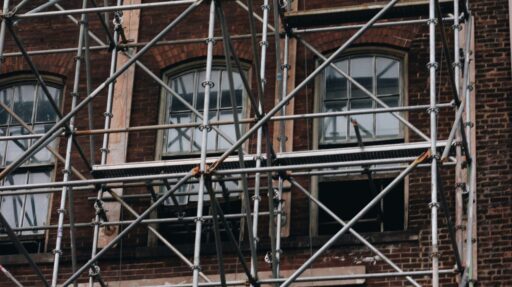
- What scaffolding adds. Scaffolding makes it possible to carry out repairs, repainting, close inspection and work on windows and balconies at the same time. If that work is needed anyway, cleaning from the scaffolding costs almost nothing extra, and the comparison changes completely.
- Chemistry and risk to the substrate. Light, frequent cleaning uses gentler treatments than a single heavy restoration campaign.
The honest conclusion for co-owners is that a drone cycle does not save money over a decade. It smooths the expenditure and keeps the facade in better condition. Nor does it eliminate the eventual need for scaffolding for a renovation. It may push that deadline back, but that is the unproven part.
Facade renovation in a copropriété: the procedure step by step
1. A trigger and a condition report
Most processes start with a complaint: a green stain, a soiled balcony soffit or moss in the gutters. A good syndic turns this complaint into a condition report: photographs facade by facade, the substrates concerned, and the nature of the problem, whether purely cosmetic or accompanied by cracks, detached render or failed joints.
This step determines everything that follows. A drone inspection flight costs little relative to the reference unit and records each facade close up. It often reveals defects that make simple cleaning the wrong proposal.
2. Check the maintenance plan and the works fund
Before requesting quotes, the syndic checks whether facade cleaning is already in the maintenance plan and whether the common budget or the works fund (in French) has sums set aside. Work that is already planned and funded usually only needs routine approval. Unplanned work, competing with other priorities such as a lift, a roof or a boiler, requires a stronger case.
3. Obtain comparable quotes
The most frequent failure at voting time comes from quotes that cannot be compared: one covers two facades, the other all four; one includes a residual biocide, the other does not; a third excludes the balconies. The next section lists what a quote must specify.
4. Put together the agenda file
General meetings are subject to fixed notice periods, and the agenda closes several weeks before the meeting. A quote that misses the deadline usually waits a whole year, and biological colonisation does not wait. Align the timetable with the cleaning season: voting in spring for work in autumn, or in autumn for work in spring, fits both the meeting calendar and the weather windows that biocides need.
The file should contain the condition report, at least two comparable quotes, the product documentation, the operator’s authorisation documents, the ten-year comparison presented above and a note on what occupants will need to do.
5. The vote
The co-owners approve the work by the majority required by your regulations for maintenance expenditure. This threshold varies between countries, and sometimes according to the nature of the work; the syndic must therefore check in advance which category the proposal falls into.
A useful option is to ask the meeting to approve a multi-year programme, for example one pass every two years for six years within a spending cap, rather than a single intervention. Where the regulations allow it, this avoids reopening the same debate every two years and cleaning becomes planned maintenance.
6. Execution and coordination with occupants
Once the work has been voted, the syndic signs the contract, informs the occupants and handles any local rules on authorisation to occupy the pavement or road if the safety perimeter encroaches on public space.
7. Closing the loop
The syndic records the date, products, surfaces treated and results, then updates the maintenance plan. The before and after photos, taken from the same viewpoints, become the condition report for the next cycle.
Drone facade cleaning quote: what it must specify to be voted through
Scope by facade and by substrate
The quote must detail each facade separately, with its approximate area and its substrate: render, EWI, brick, stone, metal cladding. It must state what is included and excluded, in particular balconies, loggias, joinery and glazing. Many co-ownership regulations treat the facade as a common part, but the inside of balconies, and sometimes the windows, as private parts. A cleaning scope that crosses this boundary causes disputes over who pays for what. Settle the question in the quote, not on the day of the work.
Products, runoff water and documentation
The quote must name the products and their dilutions, and attach documentation showing that the product is authorised for this use in your country and suitable for the substrate. It must specify where the runoff water goes. On an apartment building, this concerns drains near ground-floor gardens, courtyards and any rainwater harvesting. EWI requires particular attention, because the system’s finish often already contains biocidal and water-repellent additives, and the system holder’s recommendations must be followed.
Flight constraints specific to multi-storey buildings
An apartment building is a more demanding flight environment than a house, and the quote must show that the operator has assessed these constraints:
- Inner courtyards. Enclosed courtyards generate swirling winds, and their high walls degrade satellite positioning. Signals reflect off surrounding surfaces (multipath) and fewer satellites are visible; hover accuracy can therefore drop precisely where the drone is closest to the wall. Operators respond with alternative positioning aids or stricter wind limits, or exclude courtyards altogether.
- Height and wind. Wind speed increases with height, and gusts at the corners and roof edges of a five-storey building can exceed what a ground-level measurement suggests. Wind limits must apply at working height.
- Obstacles. Balconies, awnings, satellite dishes, cables, rooftop technical equipment and antennas all limit working distance and spray angle, and some areas are sometimes accessible only with a lance, from the ground or from the roof.
- Ground risk. Flying a heavy spraying drone over an occupied building and its surroundings generally requires an operational authorisation issued by the national civil aviation authority (the DGAC, France’s civil aviation authority), a safety perimeter and a documented site plan. The file must show that these elements exist.
Occupants’ obligations
The quote must list what occupants need to do: keep windows and air vents closed during the stated time slots, clear or cover balcony furniture and plants, and move vehicles from the designated spaces. It must also explain how camera images are handled, because an inspection or cleaning flight inevitably films windows. European data protection rules apply, and informing residents (in French) in advance of the purpose, retention period and access to the images is good practice.
Drone facade cleaning: limits and trade-offs
Cleaning can reveal bills. A close inspection or a freshly cleaned facade often uncovers cracks, hollow-sounding render, corroded fixings or failed joints that the colonisation was hiding. Co-owners should vote aware of this possibility and favour the sequence inspection, then decision, then cleaning, rather than cleaning blind.
Costs and benefits are unevenly distributed. Costs are allocated according to the apportionment key set out in the building’s regulations, usually in proportion to ownership shares or floor area. The benefits, however, are uneven. North-facing flats get their view back, while the south side notices little. Explaining that the whole envelope is a common part, and that moisture damage to a facade eventually costs everyone, generally carries more weight than an aesthetic argument.
The drone is not always the right tool. When repairs, repainting or window replacement are planned in the next few years, the scaffolding needed for that work makes a separate drone programme superfluous. The same applies when heritage substrates require manual methods, or when a courtyard or narrow street cannot be secured.
Weather adds scheduling risk. Drone passes depend on wind and dry weather. The contract must provide for what happens when a booked day is lost: postponement without penalty is the norm, and the meeting’s decision should allow for it rather than expiring on a fixed date.
Copropriété facade renovation: key points for co-owners and the syndic
For a syndic, the useful message to take to the meeting is simple. Over ten years, a drone pass every two years and a scaffold campaign once a decade cost roughly the same, about 0.10–0.18× the reference unit per co-owner per year on the reference building. The choice therefore rests on the facade condition you want to live with, the cash-flow profile the works fund can bear, and whether other work will require scaffolding anyway.
The drone cycle suits buildings with sound facades, where biological colonisation returns on identified facades, with no major work planned during the cycle, and whose site can be isolated by a safety perimeter. It does not suit buildings approaching renovation, old masonry that requires manual methods, or courtyards and street facades where a safe flight cannot be organised.
Whichever route the building chooses, the sequence is the same everywhere: condition report, check of the maintenance plan, comparable quotes, a complete file submitted in time for the agenda, and a vote by the majority required by your regulations for maintenance expenditure. Most delays and disputes come from skipping one of these steps.