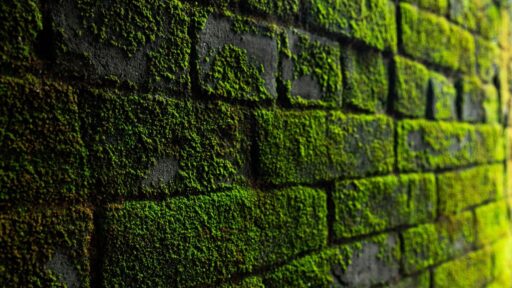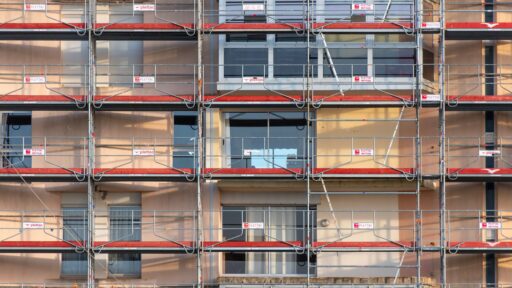

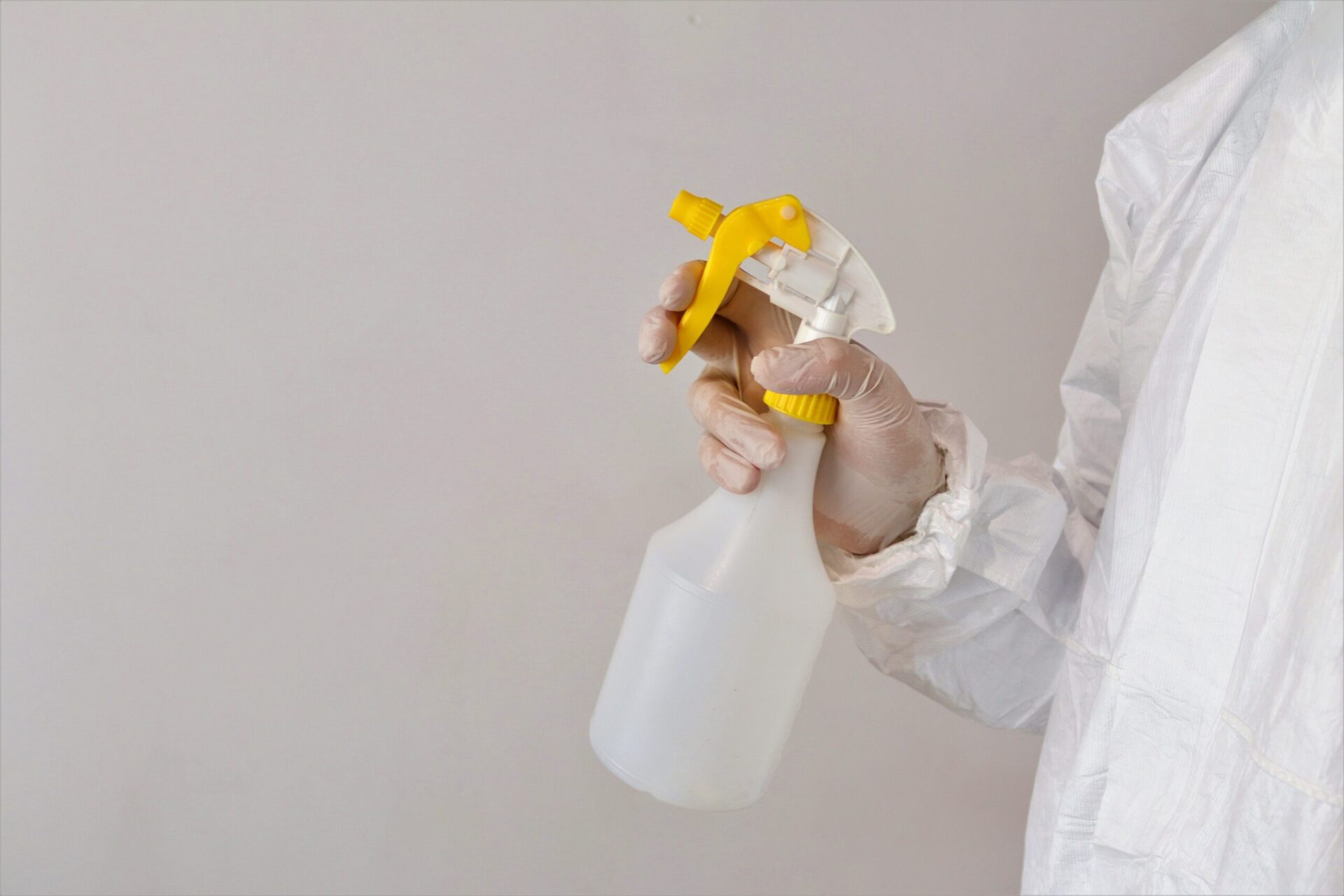
Two families of roof cleaning chemicals dominate facade and roof work in Europe. On one side, sodium hypochlorite, or bleach, which whitens a green surface in a few minutes. On the other, quaternary ammonium compounds, often called ‘quats’, which kill algae and mosses with no immediately visible change, but whose effect lasts longer. Companies often have a marked preference for one or the other, and clients receive quotes that each present their product as the only serious method. Choosing a facade cleaning product between the two is not a matter of loyalty to one family.
In reality, these two families do not do the same thing. One oxidises, the other destroys membranes. One acts fast and disappears, the other acts slowly and stays. Their risks for the substrate, plants, metals and aquatic environments are different. Choosing between them is not a question of brand but of expected result, substrate and surroundings. This article compares the two, then presents the other options.
Two mechanisms, two results
Sodium hypochlorite: an oxidising agent
Sodium hypochlorite is a powerful oxidising agent. In solution, it releases hypochlorous acid and hypochlorite ions that react with almost all organic matter: pigments, proteins, membranes, nucleic acids. On a colonised facade, the most visible effect is the destruction of the chlorophyll and pigments of algae and cyanobacteria. The green or black surface turns white or grey within a few minutes to a few hours.
This speed is its main commercial asset. But it is misleading on one point. Bleaching is not eliminating: the bleached biomass stays in place until it has been rinsed off or washed away by the rain. And hypochlorite has no residual effect: once it has reacted, it breaks down into salt and oxygen. It does not protect against recolonisation.
Its hazard profile is well documented by the INRS (in French), France’s national occupational health and safety research institute: corrosive to skin and eyes, it gives off chlorine gas on contact with an acid, which rules out any mixing with acidic cleaning products.
Quaternary ammonium compounds: surfactants that target membranes
Quaternary ammonium compounds, such as didecyldimethylammonium chloride (DDAC) or benzalkonium chloride, are cationic surfactants. Their positively charged head attaches to the negatively charged cell walls, and their fatty chains disrupt the membrane. The cell loses its contents and dies. Our article on the biology of moss removal explains this mechanism in detail.
The result is reliable destruction of algae, mosses and, more slowly, lichens, but with no immediate change in colour. The dead biomass turns brown, comes away and disappears over a few weeks to a few months, depending on the weather. In return, quats adsorb onto the substrate and form a reservoir that dissolves gradually and slows recolonisation. This is what technical data sheets call the residual effect. This effect is temporary, as each rain washes away part of the product, and a cleaning application is not a preventive treatment: the difference is explained in our article on water-repellent and anti-moss treatment after cleaning.
Point-by-point comparison
| Criterion | Sodium hypochlorite | Quaternary ammonium compounds |
|---|---|---|
| Mode of action | Non-selective oxidation | Destruction of cell membranes |
| Visible result | Fast, from a few minutes to a few hours | Slow, from a few weeks to a few months |
| Residual effect | None | Yes, of the order of a few years depending on the climate |
| Effectiveness on lichens | Discolouration, adhesion often retained | Slow, through gradual death of the thallus |
| Risk for metals | Corrosion of steel, aluminium and copper | Low |
| Risk for glass | Possible attack in concentrated, hot solution | Marks if not rinsed |
| Risk for seals | Degradation of certain elastomers | Low |
| Risk for plants | Scorching, discolouration | Toxicity depending on the dose |
| Aquatic environments | Toxic, rapid degradation | Very toxic, longer persistence |
| Dangerous mixtures | Release of chlorine with acids | Incompatible with anionic surfactants |
This table summarises general trends. Each commercial product has its own formulation, concentration and additives, and its technical data sheet takes precedence over any generalisation.
Concentration and dosage: what the figures really say
The two families have one often overlooked point in common: their effectiveness depends heavily on the concentration actually delivered to the organisms, not on the concentration printed on the container.
For hypochlorite, the concentration is given in active chlorine. Household bleach is sold at concentrations of a few per cent, and facade cleaning solutions are diluted further. The more concentrated the solution, the faster the bleaching, but the greater the risks for the substrate, metals and plants. Hypochlorite also degrades over time, with heat and with light: a solution prepared the day before and left in the sun in a tank no longer has the intended concentration.
For quats, the dose-response curve has thresholds. Below a certain threshold, the product inhibits growth without killing the cells, which produces a facade that looks clean for a season and then turns green again. Above it, it kills. Beyond the lethal threshold, additional product adds almost nothing, and most of it ends up in the runoff water. Organic matter accumulated on a heavily soiled facade absorbs part of the active ingredient before it reaches the living cells, which explains why technical data sheets sometimes recommend a higher concentration on thick colonisation.
In both cases, the practical rule is the same: follow the dilution on the technical data sheet, prepare the solution on the day, and adjust the quantity applied per square metre to the porosity of the substrate. A quote that mentions neither the dilution nor the planned consumption does not allow this point to be checked, as explained in our article on comparing quotes.
Safety of operators and occupants
Both families require precautions for people. Hypochlorite is corrosive to the skin, eyes and respiratory tract, and accidentally mixing it with an acid releases chlorine gas. Concentrated quats are irritant, or even corrosive depending on their concentration, and harmful if swallowed. Safety data sheets specify the protective equipment required for preparation and application. For occupants, the instruction is the same in both cases: windows and air vents closed during spraying, animals and children kept away from treated surfaces until they are dry.
Which product for which substrate?
Mineral renders and EWI systems
On renders, and even more so on the thin renders of external wall insulation (EWI) systems, quats are generally preferred. They act at low pressure, without mechanical action, and their residual effect delays the return of algae, which is the main problem with these facades. Hypochlorite can permanently bleach certain colours and alter organic finishes. EWI system holders often publish their own maintenance recommendations, the importance of which is explained in our article on EWI facades.
Tiles and slates
On roofs, both families are used. Quats dominate for moss removal because moss is above all a recolonisation problem and a delayed result is acceptable on a roof that is not very visible. Hypochlorite is sometimes used for a fast visual result on black cyanobacteria stains, but it attacks hooks, flashings and metal gutters, and its runs damage plants at the foot of the wall.
Natural stone and old masonry
On limestone, marble and old masonry, caution is called for with both products. Hypochlorite can leave salts in the pores and cause yellowish stains on some stones. Quats leave residues whose long-term behaviour in a heritage substrate is poorly understood. For these substrates, conservation recommendations favour test areas and the gentlest method, as explained in our article on listed buildings.
Metal cladding, window frames and glazing
On pre-painted steel, aluminium and glass, hypochlorite should be avoided or used diluted, in the shade and followed by careful rinsing. Its corrosiveness towards metals and its action on certain coatings make it a risky product on these substrates. A neutral detergent or a quat compatible with organic coatings is preferable, as detailed in our article on metal cladding. On glazing, pure water is generally preferred, as explained in our article on drone window and curtain wall cleaning.
The other options
Hydrogen peroxide and peracids. Also oxidising agents, they break down into water and oxygen, which gives them a better environmental profile than hypochlorite. Their action is fast and without residual effect. They are less aggressive towards metals, but their cost is higher and their effectiveness on lichens remains limited.
Products based on organic acids. Some products marketed as more natural rely on organic acids. They can be effective on light colonisation, but an acid attacks calcareous substrates, lime mortars and certain stones. ‘Natural’ does not mean ‘risk-free for the substrate’.
Combined formulations. Some products combine a biocide and a detergent to treat green deposits and greasy or black dirt in a single pass, without rinsing. This is the principle of BATI’NET M. On a facade that is both colonised and polluted, this approach avoids applying two products one after the other.
Use biocides safely. Always read the label and product information before use.
Water alone. On light, recent soiling, simple low-pressure rinsing, possibly with hot water or steam, is sometimes enough. It is the gentlest method, and is often underestimated.
Gentle mechanical removal. Soft brush, wooden or plastic scraper: on thick moss cushions, no product replaces physical removal if an immediate result is expected.
Regulations: what to check on the label
In the European Union, products that claim action against algae, mosses and lichens are biocidal products within the meaning of Regulation (EU) No 528/2012. Their active substance must be approved, and the product itself must be authorised for its uses, except during the transitional periods provided for by the regulation. In France, the Simmbad (in French) database, the French official register of biocidal products, makes it possible to check the status of a product placed on the market.
Check the label of any commercial product, whether it is a consumer brand, a professional range or a retailer’s own brand, for:
- the active substance and its concentration,
- the authorised uses, including the type of surface and the category of users, professional or general public,
- the application method stated, brush, knapsack sprayer or low-pressure spraying,
- the environmental restrictions, such as a ban on application before rain or near water bodies,
- the hazard pictograms and associated statements, established in accordance with the CLP Regulation.
For drone application, one additional point matters: the product authorisation specifies its application methods, and aerial spraying is not automatically covered by an authorisation intended for manual use. Our article on European drone regulations explains why this question has no harmonised answer and why it must be asked case by case.
Hypochlorite, quats and drones: what aerial application changes
Drone application mechanically favours products that require neither rubbing nor immediate rinsing: this is the natural territory of quats. Hypochlorite, for its part, poses two particular difficulties when sprayed from an aircraft.
Drift of a corrosive product. The fine droplets that drift carry an oxidising agent capable of discolouring the neighbours’ textiles, plants, car paintwork and window frames. On a ground-based job, you mask and rinse. On an aerial job, you depend on the droplet size and the wind.
Rinsing. Hypochlorite left to dry on a sensitive substrate becomes concentrated and can cause damage. Rinsing is often recommended, which increases the volume of water, the duration of the job and the load on runoff water.
Conversely, quats have their own pitfall in aerial application: since nothing changes visually on the day, both the client and the operator find it hard to check that coverage is even. Poorly treated areas only reveal themselves months later.
Hypochlorite or quaternary ammonium: how to decide
Ask yourself three questions, in this order.
What result do you expect, and when? If the aim is a clean appearance on the day, for example for a sale, a letting or an event, hypochlorite or mechanical action are the only answers, with their risks. If the aim is a facade that stays clean for longer, quats are better suited, provided you accept a gradual result.
What is the substrate, and what is around it? Metals, glazing, seals, limestone, planting and water bodies point towards the least aggressive products, often quats at a moderate dose, or even water alone.
Is the product authorised for this use and this method? The answer must appear on the label and the technical data sheet. If it does not, the choice has been made for you.
Neither family is the right one in all circumstances. A contractor who uses only one product, whatever the substrate, is selling you their method rather than a solution suited to your building.