
To answer the question in the title frankly: in drone facade moss removal, almost nothing happens to the spores in most cases — and that is precisely why the treatment works the way it does.
Spores are among the most chemically resistant structures that plants produce. The wall of bryophyte spores is built around sporopollenin, the same family of polymers that allows fossil pollen to survive millions of years in sediments. A surfactant-based biocide sprayed on a wall will not destroy them. And it does not need to. What a facade treatment actually does is kill the living, hydrated tissue occupying the surface at that moment; in doing so, it resets an ecological succession that then has to start again from the beginning. The durability of the result is therefore not a chemical property of the product. It is a biological property of the organisms and a physical property of the wall.
That distinction is the whole subject of this article, because it is also where most of the sales talk around drone facade cleaning quietly falls apart.
Before facade moss removal: what is really growing on the wall
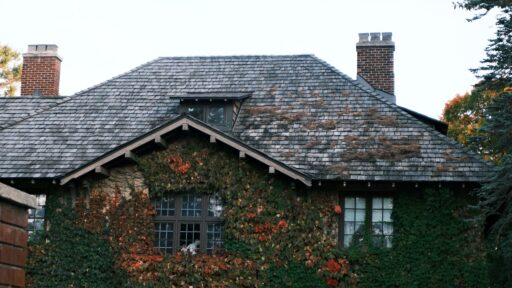
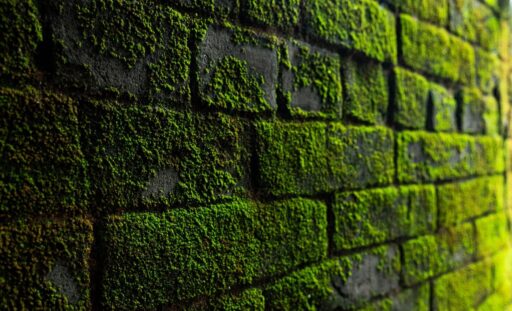
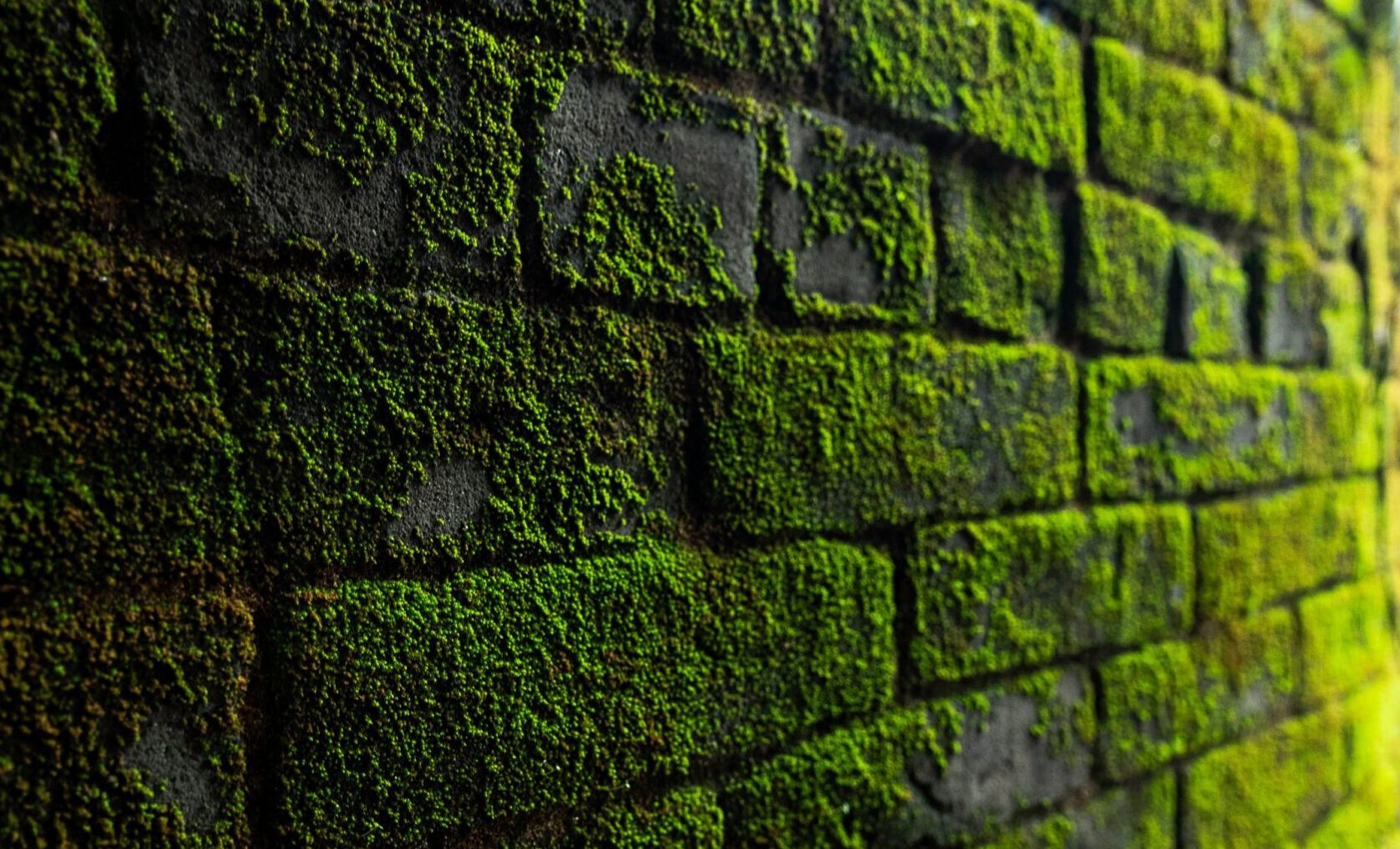
The word ‘moss’ is generally shorthand for a community organised in layers. On most European facades, the sequence is as follows: first a phototrophic biofilm of green algae (genera such as Klebsormidium and Apatococcus dominate in temperate Europe) and cyanobacteria; then crustose and foliose lichens where the surface stays damp long enough and air quality allows; and finally bryophytes, generally where fine debris has accumulated — window sills, string courses, mortar joints, parapet copings.
These three groups react very differently to a biocide and recolonise the surface at extremely variable rates. Treating them as one and the same problem is the first modelling error.
Facade mosses also spread locally through vegetative fragments and propagules (gemmae) rather than through spores. Wind-dispersed spores matter for arrival on a newly exposed surface; fragments matter for the patch that creeps along a sill. A treatment that kills gametophyte tissue immediately interrupts the second route, but not the first one at all.
Anti-moss treatment: a cellular mechanism that targets membranes, not metabolism
Most facade products authorised in Europe are based on quaternary ammonium compounds (‘quats’) — didecyldimethylammonium chloride (DDAC) and alkyldimethylbenzylammonium chloride (ADBAC/BKC) are both approved active substances under Regulation (EU) No 528/2012 on biocidal products (BPR), with surface disinfectant and algicide uses falling under product type 2, and construction material preservation uses under PT10. Some manufacturers now present green-deposit treatments as suitable for drone spraying, for example SCALP ANTI-M: as with any product, check the label for its active substance and its authorisation for the intended use.
Use biocides safely. Always read the label and product information before use.
Their mode of action is physical rather than metabolic. A quat is a cationic surfactant: a positively charged nitrogen head carrying long alkyl chains, typically C12–C16. The sequence described in the microbiological literature is as follows: adsorption onto the cell wall, penetration, reaction with the cytoplasmic membrane, disorganisation of the lipid bilayer, leakage of low-molecular-weight cytoplasmic components, degradation of proteins and nucleic acids, and finally lysis caused by the cell’s own autolytic enzymes.
Three consequences follow directly from this mechanism, and they explain almost everything professionals observe in the field.
First, the effect depends on concentration, and does so in steps. In suspension tests, quats are algistatic and bacteriostatic at around 0.5–5 mg/L, but microbicidal at 10–50 mg/L. These figures come from suspension tests on micro-organisms, not on bryophytes established on a vertical mineral substrate: they should therefore be read as the shape of the dose–response curve, not as a target to hit on a wall. It is precisely the shape that matters: below a threshold, growth is inhibited without killing, which gives a treatment that seems to have worked for one season, then not at all.
Second, the target must be hydrated. Mosses and lichens are poikilohydric: instead of regulating their own water content, they equilibrate with ambient humidity and, once dry, enter a desiccated, metabolically inert state with reorganised membranes. A membrane-disrupting agent applied to desiccated tissue has much less to disrupt and benefits from much lower uptake — this is the most underestimated variable in facade biocide application.
Third, organic matter competes for the active substance. Quats adsorb readily onto organic matter; in other application contexts, studies have measured substantial losses in available concentration on contact with organic substrates. A heavily fouled facade, covered with several millimetres of accumulated biomass, will use up a significant share of the applied dose before it reaches the living cells at the interface with the substrate.
Lichens add a further barrier. A lichen thallus is a composite organism, with a fungal cortex covering a layer of algal photobionts, often impregnated with hydrophobic secondary metabolites. Diffusion through this cortex is slow, and the killing mechanism is often indirect in practice: the photobiont is damaged, and the mycobiont dies back, deprived of food, over the following weeks. This is a fundamentally slower process than the lysis of an exposed algal film.
Facade moss removal: why ‘slowness’ is normal behaviour, not a defect
Customers expect a visible result. Biology, for its part, runs three successive clocks, and only the third one can be seen.
First clock — cell death. From a few hours to a few days on a hydrated algal biofilm; from a few days to a few weeks for lichen photobionts, protected by their cortex; an intermediate duration for hydrated bryophyte gametophytes.
Second clock — loss of adhesion. Dead rhizoids, hyphae and extracellular polymeric substances remain mechanically anchored to the substrate; this bond breaks down under the effect of hydrolysis, UV and freeze–thaw cycles.
Third clock — removal. Rain, wind and frost strip off the dead biomass. Chlorophyll photodegrades first: the colour therefore turns from green to brown or grey long before the material leaves the wall.
A treatment that produces a visible change within a few hours has almost certainly done something other than what is claimed — most probably bleaching by an oxidising agent, or simple mechanical removal by water pressure. Both can be legitimate, but neither is biocidal action, and neither implies the same durability.
Timing the anti-moss treatment: season and the European climate gradient
If uptake requires hydrated tissue and sufficient residual contact time, the application window is bounded on both sides. Too dry: the organisms are desiccated and the product dries instantly on the surface. Too wet: rain in the first few hours dilutes the active substance and washes it off a vertical wall before it has acted. Frost suspends the process entirely. Strong direct sunlight speeds up drying and photodegrades some active substances.
Across Europe, this leads to genuinely different calendars rather than a single rule:
- Atlantic and coastal north-western areas (Ireland, western Great Britain, Brittany, western Norway) have mild, wet winters and near-continuous growth. The constraint here is finding dry enough weather windows, not finding moisture.
- Central and continental Europe is constrained by cold. Late spring and early autumn are the workable windows.
- Mediterranean Europe reverses the northern assumption: biological growth there is a winter phenomenon, and summer is the dormant season. Treating a Provençal or Andalusian facade in July amounts to treating desiccated, metabolically inactive tissue.
- Coastal and estuarine exposures, everywhere, are subject to salt deposition, which changes both surface wetting and the assemblage of species present.
Timing treatment to the reproductive cycle is more often asserted than demonstrated. The argument points in the right direction — treating before the spring dehiscence of capsules eliminates sporophytes before they release their spores — but I am not aware of any controlled European field trial quantifying how much this actually changes the rate of recolonisation on a facade, rather than in the laboratory. It should be seen as a plausible optimisation, not a proven one.
Drone facade cleaning: the physics specific to aerial application
Applying a liquid to a vertical surface from a hovering aircraft introduces constraints that ground-based application does not have.
Rotor downwash dominates the local airflow. Close to a wall, this downwash forms a wall jet with recirculation zones: depending on the distance from the wall and the angle of approach, droplets may be driven onto the surface, deflected along it or drawn back towards the aircraft. Droplet size is the deciding variable: fine droplets, below about 100 µm, are highly prone to drift, while large droplets, above about 250 µm, carry more kinetic energy but run off a vertical wall instead of wetting it. Agricultural spray classification systems exist precisely to manage this trade-off, but they were designed for horizontal crop canopies; the vertical facade case is not a solved problem in the published literature.
Payload is a hard physical ceiling. One litre of water weighs one kilogram. Under the EASA framework (Regulation (EU) 2019/947), the Open category is capped at 25 kg maximum take-off mass, and its A3 subcategory requires flying well away from built-up areas — which rules out most real facades. In practice, urban jobs fall under the Specific category, under an operational authorisation based on a risk assessment, and several Member States layer additional national rules on the aerial spreading of liquids on top. In free flight, with an onboard tank, the aircraft (for example Drone Volt’s spraying drones) carries from a few litres to around ten litres, or a little more, and endurance falls as the tank is filled. Tethered systems (for example the Drone Volt Hercules 20 Spray), fed through a hose from a ground pump, avoid this limit but have to carry the hose. For a tank drone, throughput is dictated by refilling and repositioning cycles rather than by spray rate, which explains why access cost comparisons that ignore cycle time tend to be optimistic.
Surface wetting is not uniform. Aged mineral render is porous and absorbent; silicone render is deliberately hydrophobic; a dry algal biofilm is itself water-repellent. Gravity then imposes a dose gradient down the height, and parapets and copings wash the product onto the courses below. Achieving even coverage on a vertical wall is a genuinely harder problem than on a roof.
Facade moss removal: the failure modes that need naming
Overdosing does not buy durability. Beyond the biocidal threshold, the additional active substance mostly ends up in the runoff. Quats adsorb strongly onto mineral surfaces and organic matter and are not freely mobile, but runoff to soil, plantings and watercourses is a very real environmental and regulatory exposure with regard to the conditions of use set by the BPR.
Application in the wrong season produces a partial kill, which is arguably worse than nothing: the surface looks cleaner for one season, the customer expects a result lasting 3 to 5 years, and regrowth arrives after eighteen months.
Treating the symptom. Persistent colonisation is a moisture retention problem. External wall insulation (EWI) is the textbook case: the render skin, with very low thermal mass, is decoupled from the building’s heat; it cools by radiation to the night sky, drops below the dew point and holds condensation on the surface for hours after dawn. This hygrothermal behaviour is well documented in the building physics literature. Cleaning such a facade without dealing with drips, roof overhangs, defective gutters or splashback at the foot of the wall resets the clock, and nothing more.
The risk to the substrate. Codes of practice for cleaning masonry — BS 8221-1 is a widely cited example, and CEN/TC 346 covers the conservation of cultural heritage — consistently identify the rinsing and mechanical action stages, not the chemistry, as the main risk of damage to soft sandstones, lime mortars and old bricks. Purely chemical treatments avoid part of this risk, but they leave the dead biomass in place, which creates an appearance problem that customers are rarely warned about.
Confusion between product types. A PT2 surface treatment is not a PT7 film preservative or a PT10 construction material preservative. These are separate authorisations for separate functions, and a cleaning application does not, by extension, confer preventive protection.
How long facade moss removal lasts: where the 3-to-5-year figure comes from, and what it really measures
Properly broken down, this interval is not a claim about residual chemical activity. It is an estimate of recolonisation time, made up of three elements: surviving propagules and atmospheric reseeding; an establishment delay; and the time needed for regrowth to become visible at a normal viewing distance.
For lichens, the arithmetic points that way. Recorded radial growth rates for Rhizocarpon geographicum range from about 0.1 to 1.47 mm/year, with temperate-climate maxima close to 0.8 mm/year and a mean of 0.64 mm/year measured in Iceland; growth is slowest for thalli under 10 mm in diameter. Getting from a microscopic propagule to a thallus someone notices genuinely takes years.
For algal biofilm, on the other hand, the arithmetic does not point that way at all. On a north-facing EWI facade whose moisture behaviour has not changed, visible re-greening in well under two years is entirely commonplace.
The ‘3 to 5 years’ figure is therefore best read as a plausible interval for the re-establishment of lichens and mosses on a facade whose moisture regime is not pathological — and as an optimistic interval for the green algal film, which is what most customers actually complain about. I have found no published, controlled, multi-site European field trial establishing this figure for a drone-applied treatment in particular, and anyone who puts it forward should be able to say what it was measured on.
Drone cleaning in practice: where the technique belongs
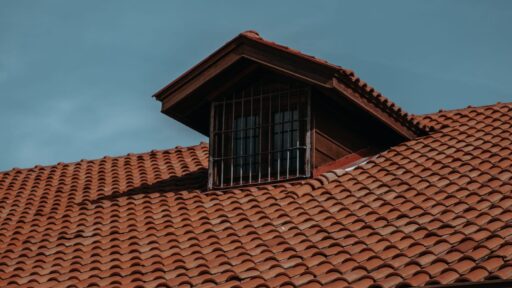
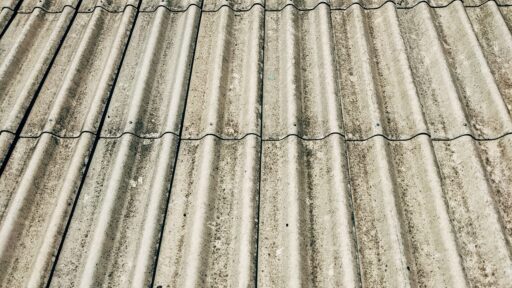
The technique is best suited to large surfaces of simple geometry and low relief, colonised biologically rather than structurally soiled: render and EWI facades, fibre cement, ribbed metal cladding, roof tiles. It is suitable when the job is part of a recurring maintenance cycle rather than a one-off restoration, because its economic case rests on repetition.
It is poorly suited to ornate or heavily modelled facades, where the shadow cast by rotor downwash leaves untreated areas; to heritage substrates for which a conservation specification requires controlled contact time and containment; to wind-exposed urban street canyons; to the vicinity of watercourses or plantings in the absence of a runoff management plan; and above all, anywhere the underlying problem is one of water management rather than biology.
If you are writing the specification for this type of work, the useful questions are precise: has the substrate been identified rather than assumed; what is the product’s BPR authorisation, for which product type and which use; which season is proposed, and why; what is the runoff management plan; what is the acceptance criterion, and when is it assessed; what moisture defect has been diagnosed alongside the cleaning; and in which EASA category is the flight authorised.
And the framing that keeps expectations honest: this is not a permanent change of state. You are buying a delay in an ecological succession, on a surface that remains — from the organisms’ point of view — perfectly habitable. The length of that delay depends mainly on how much moisture the wall retains, which is a question of construction detailing rather than chemistry.