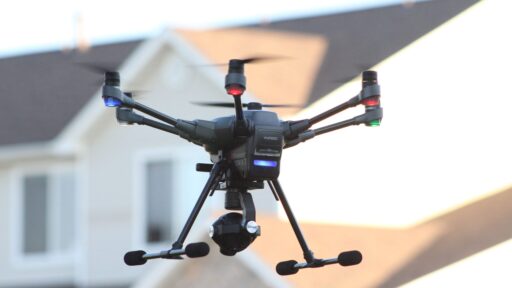
Drone cleaning carries a contradiction within it. The drones that are easiest to fly legally are small camera drones that most European countries let almost anyone fly after an online course, and they are incapable of cleaning a roof. The drones that can do the job carry a pressurised hose, a spray lance and a load of chemical product. That puts them in the part of the regulations that requires a documented risk assessment and explicit authorisation from the national civil aviation authority (the DGAC, France’s civil aviation authority; page in French). Commercial drone regulations for cleaning are built around exactly this contradiction.
Clients rarely see this difference. They see a quote, before/after photos and a date. Yet the legality of the flight over their building concerns them directly: it determines which insurance steps in if something falls, drifts or runs off onto someone else’s property.
This article explains the rules starting from the physics behind them: why cleaning drones cross the regulatory threshold, what an authorisation actually assesses, where the protection it offers the client ends, and which six documents are worth asking for, in any European country.
Drone regulations in Europe: one framework, two tiers
Since the end of 2020, EU Member States have applied a harmonised framework for civil drone operations, and several neighbouring states have adopted it. The United Kingdom is no longer part of it, but uses a similarly structured model. National details vary: which department handles applications, how long it takes, what the forms look like. The underlying logic is the same everywhere, and it rests on two tiers.
The lighter tier covers low-risk flights, with a minimum of formalities: operator registration, an online competence test and a set of fixed conditions. The aircraft weighs less than 25 kg and stays below 120 m, the remote pilot keeps it in direct sight, it does not fly over gatherings of people and it keeps a distance from uninvolved people that increases with its mass. It carries no dangerous goods and drops no material.
Anything beyond that threshold requires an operational authorisation. The operator describes the operation, assesses its risks using a structured method and proposes mitigations. The national civil aviation authority then approves it with conditions, or refuses it. Some countries offer predefined operating profiles that shorten the procedure for common scenarios. Even then, the operator must demonstrate that each flight really falls within the approved profile.
Cleaning roofs and facades above occupied buildings or public space breaches several conditions of the lighter tier at once:
- Spraying a liquid amounts to dispersing a material.
- The working position is generally a few metres from walls, pavements, neighbouring gardens and the street, where the absence of uninvolved people cannot be guaranteed.
- Drones designed for cleaning are heavy.
Any one of these points would be enough to push the job into the higher tier. In practice, all three generally apply at the same time.
Drone roof cleaning: why the aircraft are heavy, and why the authorities care
The payload calculation
The mass of a cleaning drone follows from the most basic hydraulics, not from over-engineering. Most systems (for example Skyinnov’s spraying drones) supply water through a feed hose from a ground pump (in French) rather than carrying a tank, because a useful volume of liquid would absorb all the lift capacity. But the hose itself still has to be carried.
Take a hose with a 10 mm internal diameter. Its bore holds about 0.08 litres per metre. Adding the hose wall and the fittings, a filled line weighs about 0.2–0.25 kg per metre. At a working height of 25–30 m, the aircraft is therefore lifting 5–7 kg of suspended hose before the spraying equipment is even counted.
The jet, too, pushes the drone back. The reaction force of a nozzle is roughly mass flow rate × exit velocity, and ideal exit velocity varies with the square root of pressure:
- At 100 bar and 10 L/min, water leaves the nozzle at about 140 m/s. The reaction force is about 23 N, equivalent to a 2.4 kg weight pulling the drone away from the wall.
- At 10 bar and the same flow rate, the force drops to about 7.5 N.
This is the physical reason why most drone systems practise ‘low-pressure cleaning’ (the product is applied and left to work) rather than high-pressure stripping. It is also why the flight controller has to absorb sudden jumps in thrust demand every time the trigger opens or a nozzle partially clogs, a metre or two from a facade.
Adding up the airframe, motors, batteries or electrical power cable, pump interface, hose and control margin, dedicated cleaning drones commonly weigh between about 15 and 50 kg at take-off. This range is indicative: manufacturers’ figures vary and are not always expressed in the same way. Some models exceed 25 kg on their mass alone.
Energy at ground level
The authorities measure risk by what happens to a person when an aircraft fails. A 25 kg drone falling 30 m reaches about 24 m/s and strikes the ground with some 7,400 joules. Early regulatory work on drones took an impact energy of about 80 J as a rough threshold for serious injury. Current methods are more sophisticated, but the orders of magnitude show why a heavy drone above a pavement is treated quite differently from a small camera drone above a field.
Current risk assessments combine two factors:
- The critical area: the ground footprint a failing aircraft could hit.
- The population density under the flight path.
Above a residential street, density is high and the critical area large. The operator’s usual response is a controlled ground area: a safety perimeter that keeps uninvolved people away, sized with a buffer margin in case of failure. Other mitigations include a parachute, a tether that physically limits any loss of control, and redundant propulsion. The weight given to each varies by authority and by the evidence provided by the manufacturer.
Drone facade cleaning: what a serious spraying risk assessment covers
Downwash, drift and building-specific airflow
A multirotor stays in the air by pushing air downwards. Momentum theory estimates the speed of this rotor downwash as the square root of thrust divided by (2 × air density × rotor disc area). For a 30 kg aircraft with about 1.2 m² of total rotor area, that gives about 10 m/s, a good breeze aimed straight at the treated surface.
Three effects follow:
- Wall effect. Near a vertical surface, air churned by the rotors bounces back and can create a pressure imbalance that draws the aircraft towards the wall. Research on multirotors near walls documents this phenomenon, although its magnitude depends on the design. This is one reason why safety distances and wind limits belong in the operations manual, and not to the remote pilot’s judgement on the day.
- Recirculation. Downwash striking a roof or facade is deflected sideways and upwards, carrying fine droplets with it. Research on agricultural spraying, where drift has been measured for decades, shows that droplets smaller than about 100–150 µm stay airborne long enough to travel several metres, even in light wind.
- Urban wind. Buildings accelerate wind at corners and roof edges, and generate gusts on the leeward side. A site where the weather station shows only a moderate wind can still experience turbulent, shifting wind at the gutter of an end-of-terrace house or a corner building.
The assessment must therefore specify droplet size, controlled through the choice of nozzle and the pressure. It must also set a wind limit measured at working height rather than at ground level, as well as a drift exclusion zone covering vehicles, open windows, ponds and neighbouring plants.
Chemistry is a safety issue, not just a cleaning one
The dispersal of a substance is one of the points the authorities examine most closely, because the danger does not come only from the aircraft. Among the products commonly used on roofs and facades:
- Biocides based on quaternary ammonium compounds. They are toxic to aquatic organisms: runoff into stormwater systems is therefore not harmless.
- Diluted sodium hypochlorite. It is corrosive to some metals, discolours textiles and plants, and releases chlorine if mixed with acids.
Throughout the EU, a biocidal product must be authorised for its intended use. A product approved for manual application is not necessarily approved for aerial dispersal at a given concentration. In many municipalities, the discharge of runoff into stormwater systems is also controlled separately by the water or environmental authorities. None of this falls under aviation law, but all of it belongs in the same file.
Regional climate changes the risk profile
The biological issue determines how often work is needed and which products are chosen:
- Atlantic and northern Europe: long wet seasons and low sunshine translate into abundant moss on roofs and green algae on facades; maintenance therefore recurs every few years.
- Central Europe: algae are common on external wall insulation (EWI) facades. Their thin render cools below the dew point at night through radiation, stays damp longer than solid masonry and becomes covered in algae on its north faces, the coldest. Building physics researchers have documented this mechanism well.
- Mediterranean: soiling is mainly black cyanobacterial crusts and lichens on stone. The dense historic centres of many cities add a high ground risk, narrow streets and little room for a safety perimeter.
- Coastal sites, everywhere: salt load and strong, steady winds reduce the number of days compatible with a drone’s wind limits.
Drone authorisation: what the paperwork does not guarantee
An operational authorisation is an effective filter, but it answers only one question: can this aircraft fly here without unacceptable risk to people and other aircraft? It does not answer several others.
It says nothing about the substrate. An authorised flight can still:
- etch polished limestone or marble with an acidic cleaner,
- saturate a thin render over insulation, which will eventually deteriorate,
- leave streaks on a zinc or copper roof covering,
- strip the factory coating from profiled steel sheeting.
Compatibility with the substrate is a materials question. For stone, heritage conservation bodies generally recommend a trial on a small, inconspicuous area before treating the whole.
It has a scope, and exceeding it is the most common problem. An authorisation is tied to specific aircraft types and masses, maximum heights, types of area, procedures and, often, a crew named individually. An authorisation for inspecting industrial sites does not automatically cover spraying above a residential street. The document may be genuine and yet not apply to your job.
The signatory is not necessarily the holder. Cleaning companies sometimes subcontract the flying. What matters is that the company flying over your building holds the authorisation, and that its remote pilots are indeed the ones named in it.
Borders matter. An authorisation issued in one country can generally be used in another only after notification to, or acceptance by, that country’s national civil aviation authority. The common framework allows this, but it is not automatic.
The tether is a trade-off. A tether prevents any loss of control and can provide a continuous power supply, like Elistair’s tethered stations. It also adds snagging points on chimneys, aerials and trees, as well as a pendulum load that affects flight stability in gusts.
Sometimes the drone is not the right tool. If a proper safety perimeter cannot be set up, or if forecasts rarely fall within the wind limits, the honest answer may be rope access or a mobile elevating work platform (MEWP). A risk assessment that always concludes ‘we fly’ deserves suspicion.
The cost of compliance for drone cleaning, in indexed terms
Compliance costs vary too much from one country to another for absolute amounts to be meaningful. Their share of a job is more stable. Take as the reference unit one cleaning pass on a reference house (a two-storey detached house, roof and facades). Authorisation and surveys generally add 0.1–0.3× this unit.
These are mostly fixed costs: site visit, site-specific risk assessment, local permissions, organisation of the safety perimeter and airspace checks. They do not vary with square metres. On the reference house, they represent a noticeable share of the job. On a large residential building or a warehouse roof, spread over a cleaning volume several times the reference unit, they shrink to a small percentage.
If a quote contains no compliance line item, there are two possible explanations. The first is legitimate: the operator holds a standing authorisation covering a category of similar sites and spreads its cost over many jobs. Even then, a site-specific check is still needed. The second is that this work has simply been skipped. Ask which applies.
Drone insurance and authorisations: the list of six documents to ask for
These six requests work in any European country, whatever the local name of the documents.
- Proof of operator registration (in French). Ask for the registration number and check that it appears on the aircraft as the regulations require. It identifies the legal entity responsible for the flight.
- The operational authorisation itself: the document that authorises this type of flight above a built-up area. Read the scope, not just the cover page. Does it cover this aircraft type and mass, this height, this type of area and the dispersal of liquids? Is it valid for the planned dates? For a foreign operator, has it been accepted by the country’s national civil aviation authority?
- Proof that every remote pilot on site is a certified remote pilot, qualified to the level required by the authorisation, along with any operator-specific training it provides for. The names must match.
- A site-specific operations plan and risk assessment. They must include:
- the controlled ground area and its buffer margin, marked on a plan,
- wind and weather limits at working height,
- an airspace check (in French) covering nearby aerodromes, heliports and restricted zones,
- the routing of the tether,
- emergency procedures for loss of power, loss of control and chemical spillage,
- droplet size and drift exclusion zones.
- Local permissions. These generally cover occupation or closure of public space, the agreement of neighbouring owners where the safety perimeter or flight path encroaches on their land, any required airspace coordination and, where applicable, authorisation to discharge runoff.
- The products and liability file. Ask for the safety data sheets and the authorisation status of each product for the intended use and method, the dilution rates and the runoff containment plan. Also ask for a certificate of civil liability insurance (third-party damage) that explicitly covers drone operations and the aerial dispersal of substances, with limits suited to an urban site.
Drone roof and facade cleaning: the verdict for the client
The technique is well suited when its physics and fixed costs work in its favour:
- large or complex roofs that are hard to access,
- low-rise buildings whose surroundings can genuinely be isolated by a safety perimeter,
- planned maintenance programmes, where the surveys and authorisation are done once and then reused.
It is poorly suited when those same factors turn against it:
- narrow streets that cannot be closed,
- fragile heritage surfaces that require controlled application by hand,
- windy coastal sites offering few usable flying days,
- very small jobs, where 0.1–0.3× in fixed costs makes other means of access competitive.
More broadly, regulation is not an obstacle that the operator clears on your behalf and then forgets. The authorisation, the site plan and the insurance are what make aerial application of chemicals above an occupied building a controlled operation rather than an improvisation. A competent operator will already have the six documents ready. If one of them is hard to obtain, treat that as useful information before signing.
A note on accuracy: the drone masses, droplet drift thresholds and impact energy reference values quoted above are indicative orders of magnitude drawn from engineering practice and published research, not regulatory limits. Check the exact thresholds and procedures with the national civil aviation authority of the country where the work takes place.