
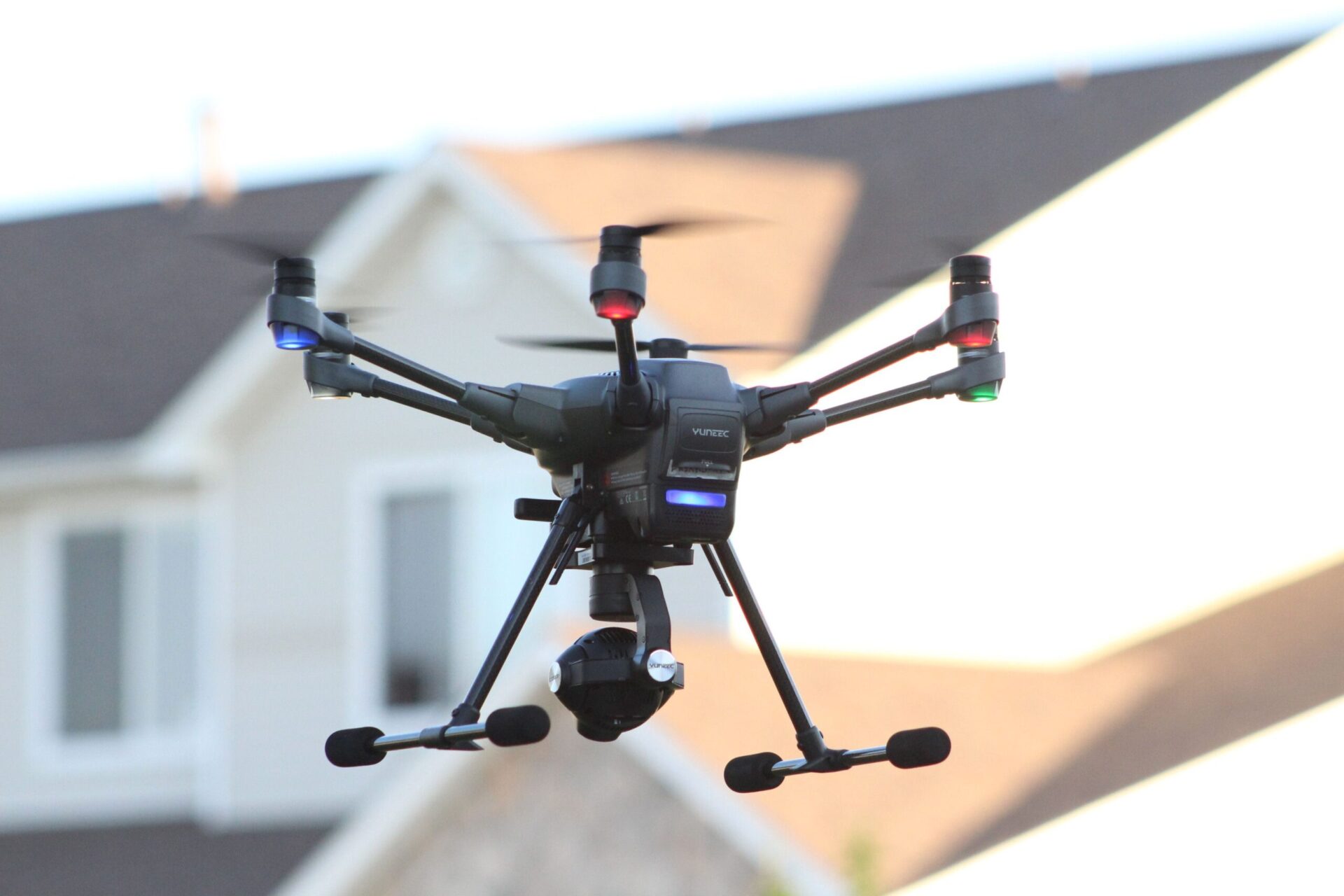
A drone cleaning job lasts a few hours. For the owner who ordered it, it is an obvious improvement on three weeks of scaffolding. For the neighbour, it is a noisy aircraft flying a few metres from their bedroom window, camera pointed at a party wall, and perhaps leaving a few droplets on their car. Reactions range from amused curiosity to a complaint to the gendarmerie, the French police force that covers many residential areas. Drone privacy laws are therefore worth checking before the aircraft takes off.
Neighbour disputes linked to cleaning drones almost never fall under aviation law. They fall under the right to privacy, personal data protection, property law and nuisance between neighbours. These are subjects that neither the operational authorisation nor the remote pilot certificate deals with. This article reviews the four sources of dispute and the simple practices that avoid them.
Overflying a neighbouring property: what the law says
The principle of free overflight, and its limit
In France, Article L6211-3 of the French Transport Code (in French) states that the right of an aircraft to overfly private property may not be exercised in conditions that would hinder the owner’s exercise of their rights. Overflight is therefore possible, but not under just any conditions. A drone that hovers for a long time a few metres above a neighbouring garden, sprays product onto it or prevents its occupants from enjoying it is clearly approaching that limit.
Aviation rules
Regulation (EU) 2019/947 governs distances from uninvolved persons and the management of ground risk. In the Specific category, which covers all spraying flights, the risk assessment relies on a controlled ground area: a space where the operator guarantees the absence of uninvolved persons. When this area encroaches on a neighbouring property, the operator can only control it with the agreement of its occupant. Our article on drone regulations and building cleaning explains these mechanisms in detail.
In practice, this means that cleaning a roof on a property boundary, on a semi-detached or terraced house or in a dense housing estate almost always requires the written agreement of the neighbours whose land lies within the flight area or its safety margin. Without this agreement, the risk assessment does not hold up.
Images: on-board cameras, personal data and privacy
Every cleaning drone films
A cleaning drone carries at least a piloting camera, often an inspection camera and sometimes a thermal camera. These cameras capture everything within their field of view: the facade being treated, but also neighbouring windows, gardens, terraces, people and number plates.
What the GDPR says
As soon as images make it possible to identify a person, directly or indirectly, they constitute personal data within the meaning of the General Data Protection Regulation. The company that collects them in the course of its professional activity is responsible for them. It must have a legal basis, which will generally be its legitimate interest in documenting the job. It must limit collection to what is necessary, inform the people concerned, set a retention period and secure the images.
The CNIL (in French), the French data protection authority, sets out these principles for recreational drones, and they apply a fortiori to professional uses. Filming a client’s facade to document its condition is legitimate. Keeping for years images in which the inside of a neighbour’s bedroom can be seen is not.
What the French Criminal Code says
Beyond the GDPR, capturing a person’s image without their consent while they are in a private place is an offence under Article 226-1 of the French Criminal Code (in French). An enclosed garden or the inside of a home are private places. Accidental, brief and unused capture obviously does not carry the same weight as deliberate capture. But it is one more reason to point cameras carefully, not to linger in front of neighbouring windows and never to publish job images showing third parties without blurring them.
Posting on social media
Many companies post before-and-after videos of their jobs. It is an excellent sales tool, and it is also the main source of image-related disputes. A video in which the neighbour’s house, car or swimming pool can be recognised may be enough to trigger a complaint. Good practice consists in obtaining the client’s written agreement for publication, framing shots on the building being treated and blurring anything that makes it possible to identify third parties.
Product drift onto the neighbour’s property
Spraying produces a fraction of fine droplets that the wind and rotor downwash can carry several metres. On a ground-based job, you mask and protect. On an aerial job, you depend on the droplet size, the working height and the wind.
The most frequent types of damage are well known:
- car bodywork, on which hypochlorite can leave marks and biocides can leave rings,
- glazing and window frames, marked by dried runs,
- plants, scorched or discoloured,
- washing hung out to dry, discoloured by oxidising agents,
- ponds and pools, where a biocide can kill fish and amphibians.
This damage engages the operator’s liability, and whether it is covered depends on their insurance. Our article on drone insurance explains why damage caused by the sprayed product, as opposed to damage caused by the aircraft, can fall between two policies. The choice of product also affects the severity: our comparison hypochlorite or quaternary ammonium shows that hypochlorite, being corrosive, causes more visible damage in the event of drift.
Why drift is more frequent than people think
The physics of spraying explains why this risk is structural. The choice of nozzle and pressure determines a spectrum of droplet sizes, never a single size. Even a nozzle set to produce coarse drops produces a fraction of droplets under 100 µm, which fall slowly and follow the movement of the air. Work from agricultural research, where drift has been measured for decades, shows that these droplets can travel several metres in light wind, and further in moderate wind.
On top of this comes rotor downwash. A cleaning drone weighing several tens of kilos pushes air downwards at a speed of around 10 m/s. When this airflow hits a roof or facade, it is deflected sideways and upwards, carrying some of the droplets with it. Near a party wall or a property boundary, this recirculation can be enough to project product onto the neighbour’s property, even in calm weather.
The practical consequence is simple: on a job on a property boundary, you must either protect what lies on the other side, with the neighbour’s agreement, or give up spraying the nearest strip and treat it another way, for example by hand from the roof or with a low-pressure lance from the ground.
Noise, disturbance and abnormal nuisance to neighbours
A cleaning drone weighing several tens of kilos is noisy, especially at close range. The job also requires windows to be closed, vehicles to be moved and certain areas to be kept clear for a few hours.
Since 2024, Article 1253 of the French Civil Code has explicitly enshrined liability for abnormal nuisance to neighbours, a concept built up over decades by case law. The nuisance must exceed the normal inconveniences of neighbourhood life, and whether it is abnormal is assessed case by case, notably according to its duration, intensity, repetition and location. A cleaning job lasting a few hours, announced in advance, is unlikely to be judged abnormal. Repeated, unannounced work, early in the morning or at weekends, or accompanied by damage, changes the assessment.
The special case of apartment buildings and semi-detached or terraced houses
In an apartment building, the neighbours are not just on the other side of the fence: they are behind every window of the facade being treated. Cleaning the facade of a copropriété, the French system of co-ownership of a building, therefore affects dozens of homes at once, with occupants who did not all attend the general meeting that voted for the works. In semi-detached and terraced houses, the roof often runs continuously from one property to the next, and the boundary between the two lies on a ridge or a separating wall. Treating half of a continuous roof without spilling over onto the neighbour’s side requires a precision that the wind does not always allow, and many owners find it simpler to suggest to the neighbour that both sides be treated at the same time, each paying their share.
Practices that avoid conflict
Most disputes can be prevented by simple steps, provided they are planned into the organisation of the job.
Inform in advance
A letter or notice put through neighbours’ letterboxes a few days before the work is enough to defuse most conflicts. It should state the date and times, the nature of the work, the precautions requested, such as closing windows, bringing in washing or moving vehicles, how images will be handled and a contact reachable on the day of the job. In an apartment building, notices in the common parts and information from the syndic, the managing agent of a French co-owned building, complete the arrangements, as described in our article on facade renovation in a copropriété.
Obtain written agreement when the flight encroaches
When the flight area or the controlled ground area encroaches on a neighbouring property, the neighbour’s written agreement is essential. It specifies the date, the area concerned, the precautions taken and, where applicable, the protection installed on their property. It is also an opportunity to carry out a joint inspection of exposed items, such as a conservatory, a car or a pond.
Frame the cameras
During the flight, the documentation camera is pointed at the surface being treated. Footage in front of neighbouring windows is avoided or kept to a minimum. Images are kept for a limited period, justified by the documentation of the job and the time allowed for complaints, then deleted.
Protect the surroundings
Covers on vehicles and sensitive plants, protection of ponds, a strict wind limit, droplets large enough to limit drift and an immediate stop if the wind turns towards a neighbouring property. A handheld anemometer, such as those in the Kestrel range, makes it possible to check the wind on site rather than rely on a forecast.
Document
Time-stamped photographs of the surroundings before and after the work, including exposed neighbouring items, make it possible to settle a complaint quickly. They protect the neighbour as much as the company.
Cost of managing the neighbours
Expressed in the reference unit of our articles, one drone cleaning pass on a reference house, managing the neighbours represents a modest but real cost.
| Measure | Indicative cost (× reference unit) |
|---|---|
| Written information for neighbours | Negligible |
| Collecting written agreements and joint inspection | 0.02–0.05× |
| Protection of neighbouring vehicles, plants and ponds | 0.03–0.1× |
| Blurring images before publication | 0.01–0.03× |
Compared with the cost of a single dispute, which can exceed the price of the job if a car body has to be resprayed or a marked conservatory replaced, these amounts are small.
Drone privacy: the questions to ask the company
Before signing, ask the company:
- How will the neighbours be informed, and by whom?
- Does the flight area or the controlled ground area encroach on a neighbouring property, and how will agreement be obtained?
- Which cameras will be used, what will they film and how long will the images be kept?
- Will the images be published, and under what conditions?
- What protection is planned against drift, and does the insurance cover damage caused by the product on neighbouring properties?
A company used to jobs in built-up areas answers these questions without hesitation, because that is what allows it to work with peace of mind. Drone cleaning considerably reduces the disturbance to neighbours compared with scaffolding lasting several weeks. It does not eliminate it, and it creates new forms of it. Anticipating them costs little; ignoring them costs a lot.