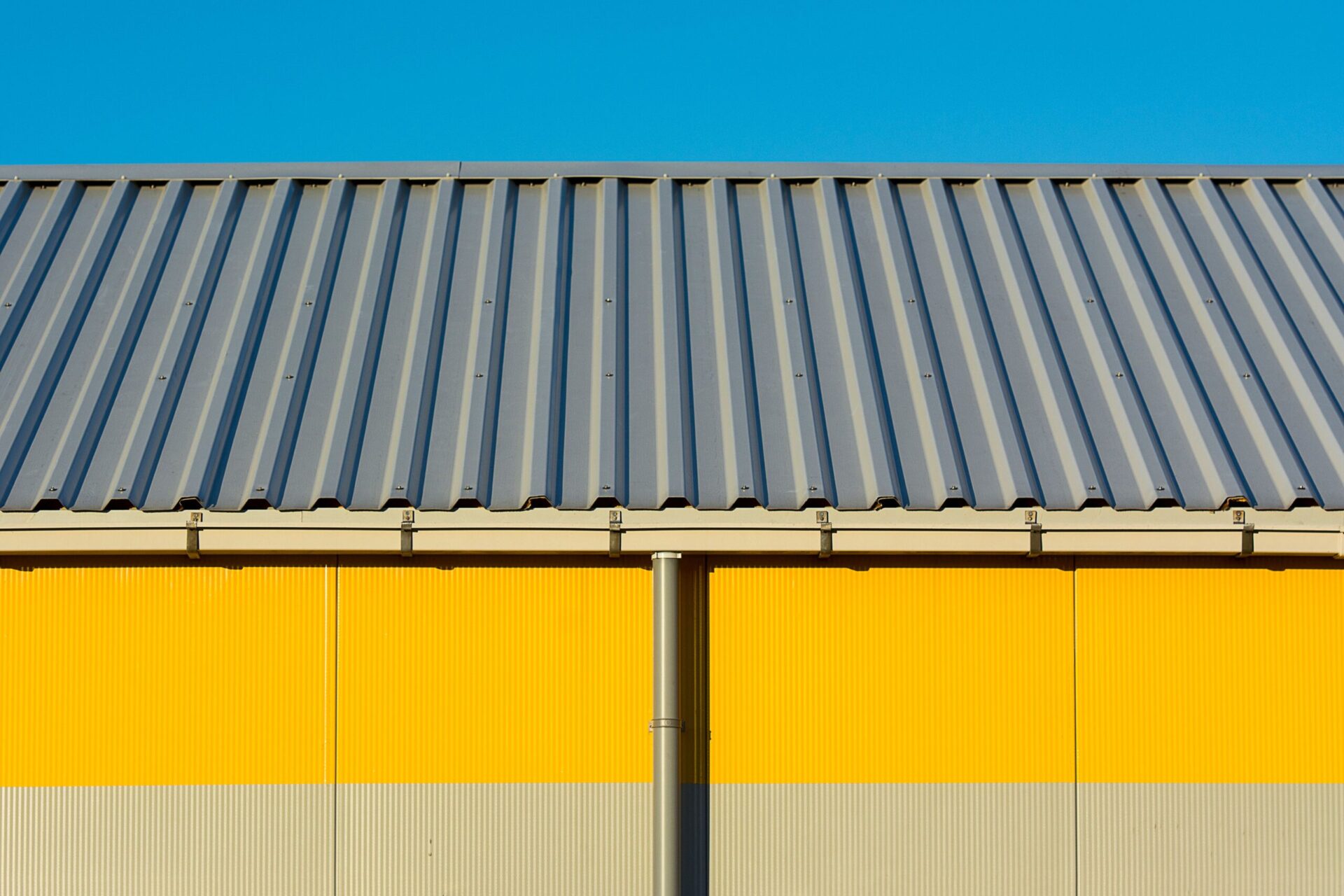
On paper, industrial and logistics buildings are the ideal terrain for drone cleaning. Their facades are large, flat, repetitive and free of balconies or cornices. Their surroundings are often car parks or delivery yards that can be closed off for a few hours. Their managers think in terms of operating costs, not aesthetic taste. And a 20 m mobile elevating work platform (MEWP) that has to be repositioned fifty times along a 200 m warehouse is a machine that spends more time driving than working. Metal cladding cleaning is where that advantage is put to the test.
Yet metal cladding is not a neutral substrate. What protects the steel from corrosion is an organic coating a few tens of micrometres thick, and that coating can be worn, attacked or stained by badly managed cleaning. Industrial sites also add their own constraints: co-activity, prevention plans, hazardous areas, and even overflight bans. This article explains why and how cladding is cleaned, and in which cases the drone really is the right tool.
Metal cladding: how the coating works
Pre-painted steel cladding or roofing is a stack of layers applied in the factory, continuously, onto steel coils (‘coil coating’):
- the base steel,
- a metallic coating, usually zinc galvanising or a zinc-aluminium-magnesium alloy,
- a conversion treatment and a primer, which ensure adhesion,
- an organic topcoat, whose type determines durability: polyester, high-durability polyester, polyurethane, PVDF or plastisol.
The requirements for these products are set in Europe by EN 10169, which notably defines categories of resistance to corrosion and UV. Manufacturers then publish ranges suited to different environments. ArcelorMittal, for example, markets its Granite® range in different versions depending on exposure and the durability sought.
The environment is classified according to the atmospheric corrosivity defined by ISO 9223, from C1 (dry interior) to CX (extreme conditions). A warehouse in a rural area is often C2 or C3. A building on the seafront, near a road salted in winter or close to an emitting industry can reach C4 or C5. It is this class, combined with the type of coating, that sets the expected service life of the cladding.
Cladding soiling: three phenomena to distinguish
Chalking
Under the action of UV, the resin of the organic coating degrades at the surface and releases the pigments as a fine powder. The cladding becomes dull, and a finger run over it comes back coloured. Chalking is normal ageing. It cannot be cleaned in the true sense: the loose powder can be removed, but the original gloss cannot be restored. Overly vigorous cleaning even accelerates the phenomenon by wearing away the still-sound layer.
Deposits and biological colonisation
Traffic dust, industrial soot, pollen, bird droppings and, on north-facing and shaded faces, algae and lichens accumulate on cladding. On a smooth coating, biological colonisation is slower than on a porous render, but it settles in the ribs, around fixings and at the foot of facades exposed to splashing.
Areas not washed by rain
This is the most important point, and the least known. On a building, some areas never receive rain: under roof overhangs, under loading-dock canopies, behind downpipes, in the shadow of technical equipment. Salts, dust and pollutants accumulate there without ever being rinsed off. They retain moisture from dew and create a permanent electrolytic film on the coating. It is in these sheltered areas that corrosion starts first, not on the faces exposed to the weather.
Manufacturers know this. ArcelorMittal’s user manual for organic coated steels recommends periodic maintenance of surfaces not washed by rain, and many coating warranties make it a condition. In other words, on an industrial building, cleaning is not just a matter of image: it can determine whether the cladding warranty holds.
Cleaning cladding: what is allowed, what is forbidden
Coating manufacturers’ recommendations are similar from one brand to another. They converge on a few rules:
- Water and neutral detergent. Washing is done with clean water, possibly with a mild pH-neutral detergent added, followed by thorough rinsing. For greasy pollution deposits, a non-foaming facade degreaser that its manufacturer states can be applied by drone, such as SCALP AQUA 05, can be used after checking its compatibility with the coating on a test area.
- No aggressive solvents, abrasives or strong alkaline or acidic products. They can soften, scratch or discolour the coating.
- Controlled pressure and sufficient distance. A pressure washer at short range can lift the coating at cut edges, perforations and fixings, where the steel is already exposed.
- No cleaning in full sun on hot sheet metal. The product dries and concentrates, leaving marks.
- Take care with edges and cuts. Cuts made on site, where the steel is protected only by galvanising, are the most vulnerable points.
For biological colonisation, a biocide may be necessary. It must be authorised for this use and compatible with organic coatings, which the technical data sheet should state. Concentrated hypochlorite left to dry is a classic cause of discolouration of paint finishes, particularly on dark colours. Our article on choosing between hypochlorite and quaternary ammonium compounds details these trade-offs.
Why the drone suits industrial buildings
Geometry works in its favour
Warehouse cladding is a flat or ribbed surface, continuous, with no projections. The rotor downwash does not create shadow zones as it does on an ornate facade, and spray coverage is even. Heights, often 10 to 15 m, remain within the range where a ground-powered drone works comfortably.
Access costs of other methods are high
On a 200 m long building, a MEWP has to be repositioned dozens of times: fold up, drive, stabilise, level again. Each move is billed unproductive time. Yard surfaces, often laden with buried networks or light-duty paving, sometimes require spreader plates under the outriggers. Scaffolding makes no sense for simple washing. Our comparison of access methods shows that the drone’s advantage grows with surface area and height, and logistics buildings are the clearest illustration of this.
Fragile roofs are avoided
Many industrial roofs combine profiled steel sheeting with rooflights in translucent sheets, or retain old fibre cement sheets. These elements cannot bear a person’s weight, and falls through fragile roofs are one of the recurring causes of serious accidents in industry and logistics. The drone removes human presence from the roof. If the roof contains sheets dating from before 1997, the question of asbestos comes first.
Activity can continue
A drone job occupies a limited area for a few hours, which makes it possible to maintain most logistics flows by moving the safety perimeter as work progresses. A MEWP blocks a traffic lane for a long time, and scaffolding blocks the loading docks.
Cladding cleaning on industrial sites: constraints to anticipate
The prevention plan
When an outside contractor works on an operating site, the French Labour Code requires coordination between the host company and the contractor. A joint preliminary inspection takes place, then a prevention plan (in French), the written document setting out the joint safety measures, is drawn up when the risks of interference between activities require it. Flying a heavy drone over a yard where forklifts and lorries are moving is exactly the kind of co-activity this arrangement targets. The safety perimeter, working hours, any shutdown of certain flows and emergency instructions are set out in it.
Hazardous areas and classified installations
Some sites have areas where any ignition source is prohibited, such as storage of flammable products or explosive atmosphere zones. A drone is electrical equipment. It must not fly over these areas without a specific analysis, and it must under no circumstances enter them. Establishments covered by the Seveso III Directive also have their own security rules, and many are subject to overflight restrictions set out in the national UAS geographical zones. Checking the airspace is part of the file, as our article on European drone regulations explains.
Air intakes and technical equipment
Air handling units, extractors, fresh-air intakes and chillers draw in outside air. Spraying nearby can introduce product into the premises or into a sensitive process, such as a food cold store or a clean room. The site plan must identify this equipment and provide for its shutdown or protection during spraying.
Runoff water
Industrial sites often have separate sewer systems, oil separators and discharge agreements with the network operator. Wash water from cladding, especially when loaded with biocide, is not ordinary stormwater. You need to know where it goes, and whether the site’s order or discharge agreement allows it. Our article on managing runoff water details these questions.
Cost of drone cladding cleaning
The orders of magnitude below use the reference unit common to our articles: one drone cleaning pass on a reference house, roof and facades included. They are indicative and vary with height, accessibility, level of soiling and site constraints.
| Building | Indicative cladding area | Drone (× unit) | MEWP (× unit) |
|---|---|---|---|
| Small business unit | 800–1,500 m² | 2–4× | 4–7× |
| Medium logistics warehouse | 3,000–6,000 m² | 5–10× | 12–25× |
| Large logistics platform | 10,000 m² and more | 12–25× | 35× and more |
The trend matters more than the exact figures. The drone’s fixed costs, such as the site visit, the authorisation and the prevention plan, weigh heavily on a small building and become marginal on a large platform. The MEWP, for its part, sees its cost grow almost linearly with facade length, since each bay requires repositioning.
For a property portfolio manager, the main economic benefit lies in frequency. Annual or biennial washing of the areas not washed by rain, inexpensive by drone, can extend the service life of the coating and preserve the warranty. The same frequency with a MEWP quickly becomes prohibitive, and maintenance is then postponed until corrosion appears.
The limits of drone cladding cleaning
Mechanical washing remains limited. A free-flying drone cannot deliver the pressure and flow of a professional washer without being destabilised by the reaction force of the jet. The most powerful systems, such as the Lucid Bots Sherpa, are supplied with water and power from the ground to get round this problem, but they remain low- or medium-pressure washing tools. Greasy deposits, ingrained soot or rust streaks sometimes require targeted manual cleaning.
Wind on large volumes. Large buildings generate wind acceleration at corners and along roof edges. A wind limit measured on the ground can be exceeded at 12 m height at the corner of a warehouse.
Inspection does not replace a survey. The flight makes it possible to spot areas of corrosion, loose fixings and damaged edges. It does not allow the residual thickness of the coating or the adhesion of the paint to be measured. If corrosion is advanced, the question is no longer cleaning but renovation of the cladding.
A degraded coating cannot be repaired with a jet. Heavily chalked or already corroded cladding may require repainting or partial replacement. Cleaning is then the first step, but it is not enough.
Metal cladding cleaning: the essentials for a site manager
Drone cleaning is particularly suited to large-area industrial and logistics buildings with sound cladding, where the goal is regular maintenance of both exposed and sheltered areas, where the surroundings can be closed off sector by sector, and where no hazardous area prevents overflight. It is poorly suited when the coating is already degraded, when the soiling requires strong mechanical action, or when the site is subject to overflight restrictions that no analysis can lift.
Before ordering, gather four items: the reference and warranty of the cladding coating, the site’s corrosivity class, the prevention plan drawn up with the contractor, and where the wash water goes. With these four documents, the choice between drone, MEWP and manual washing almost makes itself.