
A roof cleaning quote almost always describes the area in square metres and the problem in one word: ‘moss’. It rarely describes the material, which nonetheless decides almost everything: tolerable pressure, compatible product, speed of recolonisation and risks. A well-fired clay tile and a thirty-year-old concrete tile have nothing in common but their shape. A natural slate and a fibre cement slate look alike from a distance, but one is a rock and the other a composite that may contain asbestos. Drone roof cleaning has to start from the material, not from the moss.
The drone changes the way the roof is reached, not the physics of the material. Here are the five most widespread families of roof covering in Europe, how they behave when faced with water, pressure and chemicals, and the cases where aerial application is a real step forward.
Roof cleaning: why the material matters more than the method
Three properties govern how a roof covering reacts to cleaning.
Open porosity and water absorption. A porous material soaks up the cleaning water and the product. That is a good thing for the penetration of a biocide, and a bad thing when the material then has to get through a saturated winter. Absorption also determines the speed of recolonisation: a surface that stays damp for longer is colonised by algae more quickly.
The surface skin. Many roof coverings have a surface layer that is denser or smoother than their core: the fired skin of a clay tile, the engobe or glaze that sometimes covers it, the pigmented finishing layer of a concrete tile, the organic coating of profiled steel sheeting. Cleaning that wears away this skin accelerates ageing, even if the roof looks clean.
The mechanical strength of thin elements. Discontinuous roof coverings are made of thin elements laid overlapping one another. Their edges, nibs and exposed margins are the most fragile areas, and they are precisely the ones a jet strikes when it is directed up the slope.
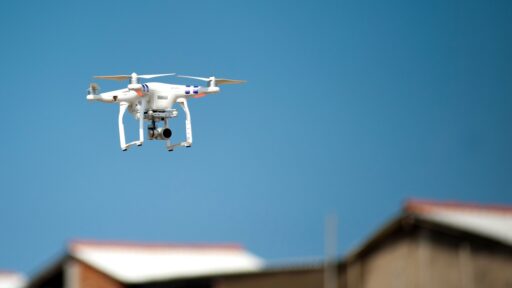
The drone acts on only one of these variables: it removes the need to walk on the roof. That is far from trivial. Falls from height remain the leading cause of fatal accidents in construction (in French), and walking on a roof breaks tiles, cracks slates and dislodges elements that were not leaking. In France, the French Labour Code requires temporary work at height to be carried out from a secure working platform (in French), which, for a simple cleaning job, often accounts for most of the cost. But a drone that sprays at the wrong pressure or with the wrong product damages the roof just as surely as a poorly equipped roofer.
Clay tiles: protecting the fired skin
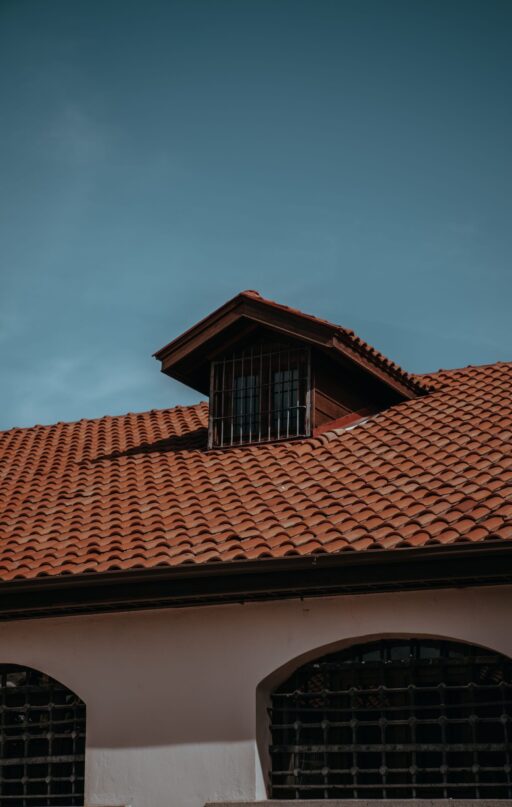
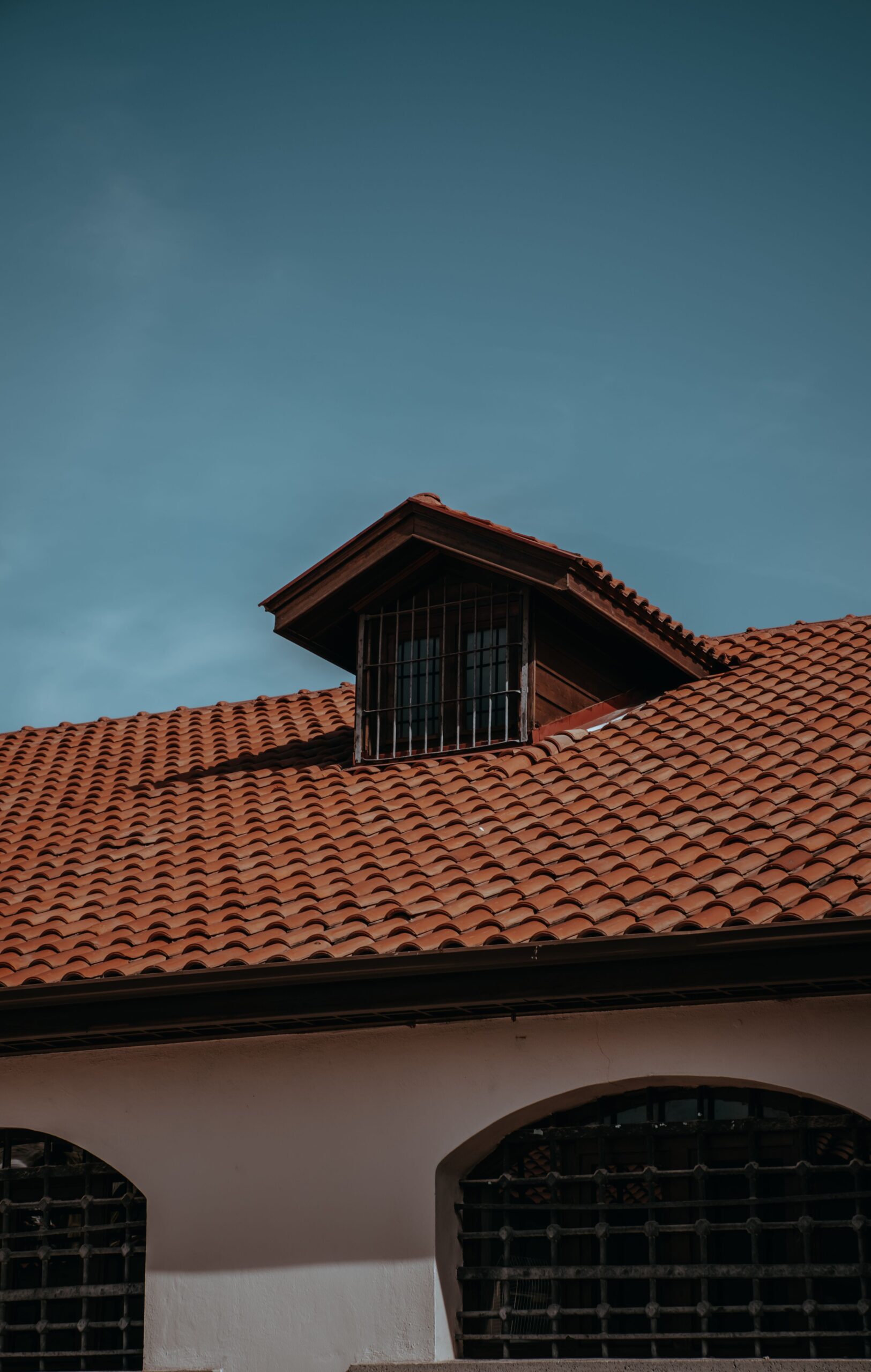
The clay tile is the most widespread roof covering in France and in much of southern and western Europe. In Europe, clay tiles fall under product standard EN 1304, and their frost resistance is tested according to EN 539-2, with test methods that differ between climatic regions.
How it ages. A well-fired tile has low absorption, often of the order of a few per cent of its mass, and a dense surface. Over the years, freeze-thaw cycles, atmospheric deposits and biological colonisation gradually open up this surface. Moss cushions play a particularly aggravating role: they hold water like a sponge against the tile and prolong wetting well beyond the shower. Where moss builds up in the overlaps, it can also draw water up by capillary action towards the top of the exposed margin, as far as the tile above.
What damages it. High pressure is the main enemy. A professional pressure washer at 100–150 bar held at close range can strip off the fired skin, dull engobes and pit the surface. The tile looks lighter and cleaner, but it has become more absorbent and rougher, and therefore easier to recolonise. Glazed or engobed tiles are the most sensitive: engobe is a layer of fine clay applied before firing, and once it has been damaged, it does not regenerate.
What works. Low-pressure application of a biocide authorised for this use, left to act, followed by the gradual removal of the biomass by the rain. Some products, such as SCALP ANTI-M, are presented by their manufacturer as suitable for drone spraying. Thick cushions may justify manual scraping beforehand, which puts a person back on the roof. This is where the drone shows its limit: it kills the moss, but does not remove it on the day. Some tile manufacturers also advise against any water-repellent treatment applied after installation: check their recommendations before accepting a finishing treatment.
Use biocides safely. Always read the label and product information before use.
Concrete tiles: when the finishing layer has already gone
Concrete tiles, governed by standard EN 490, have been very widespread in the United Kingdom, Germany, the Benelux countries and part of France since the 1960s. Their original surface is a thin coloured layer, a mortar rich in cement and pigments, sometimes covered with an acrylic sealer.
How it ages. This finishing layer erodes over one to three decades depending on exposure. The aggregates appear, the surface becomes rough and porosity increases. A thirty-year-old concrete tile is therefore often much more bioreceptive than a new tile. This is also why concrete roofs recolonise quickly after poorly executed cleaning.
What damages it. A high-pressure jet removes what remains of the pigmented layer in a few passes. The resulting difference in colour is permanent. Stripping off fine laitance also blocks gutters and downpipes, which is not just a maintenance detail.
What works. The same protocol as for clay: low pressure, authorised biocide, contact time. On a tile that is already bare, cleaning will not improve the appearance beyond a certain point, and repainting the roof is a separate debate, because it adds a film to a substrate designed to breathe.
Natural slate: a hard material, fragile fixings
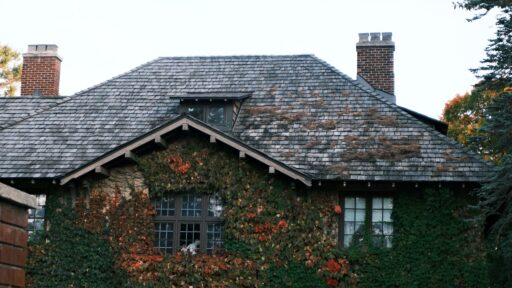
Natural slate, covered in Europe by standard EN 12326, is a very fine-grained metamorphic rock with low absorption and great durability. Slates from Anjou, Spain or Wales often last more than a century.
How it ages. The slate itself is colonised mainly by lichens and algae that settle in the micro-relief of the cleavage and along the overlaps. What ages fastest is not the stone but its fixings: stainless steel or copper hooks, copper nails, sarking boards. A hook-fixed slate is held by a metal tab a few millimetres wide.
What damages it. A jet directed up the slope, under the overlap, can lift a slate whose hook has worked loose, or drive water between the courses. Crustose lichens adhere strongly to the surface, and trying to remove them mechanically damages the stone without guaranteeing a result. Copper or zinc metal parts close to the treated surface also react with certain oxidising products.
What works. A gentle chemical treatment, applied from the top of the slope downwards so that the jet never travels up under the overlaps. This is a point where the drone has a real advantage: it can position itself above the roof and spray in the direction of flow, without anyone walking on brittle slates. For slate roofs on heritage buildings, the prior question remains whether cleaning is necessary at all.
Fibre cement slates and sheets: the asbestos question first
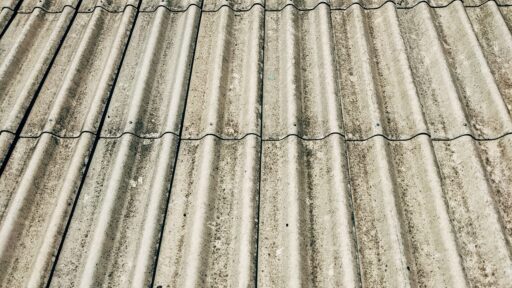
Fibre cement slates and corrugated sheets look like natural slate or profiled sheeting, but their composition is entirely different. Standard EN 492 covers fibre cement slates and EN 494 profiled sheets.
The decisive point is the date of manufacture. In France, asbestos has been banned since 1 January 1997, and the ban was extended throughout the European Union by 2005 at the latest by Directive 1999/77/EC. A fibre cement roof laid before these dates may contain asbestos cement. As long as its composition has not been established, no cleaning should be considered. The subject is important enough to have its own article.
How it ages. The surface of asbestos cement erodes under acid rain and colonisation, which gradually releases fibres. Aged sheets also become brittle: they cannot bear a person’s weight, which makes them one of the leading causes of fatal falls through a roof.
What damages it. Any process that wears the surface. High-pressure cleaning of an asbestos cement sheet is not cleaning; it is work on an asbestos-containing material, with all the obligations that follow from that. Asbestos-free fibre cement, manufactured after the ban, is less problematic from a health point of view, but its surface remains soft.
What works. Once the absence of asbestos has been established by a survey, a low-pressure chemical treatment. The drone then removes the risk of falling through the sheets, a considerable advantage on this type of roof.
Profiled steel sheeting and metal roofs: the organic coating is the real material
Pre-painted steel roofing and cladding dominate agricultural, industrial and commercial buildings. What protects the steel from corrosion is not the metal itself, but a succession of layers: galvanising, primer and organic finishing coat (polyester, polyurethane, PVDF or plastisol), applied continuously in the factory in accordance with the requirements of EN 10169.
How it ages. The coating chalks under UV: the resin degrades at the surface and releases a fine pigment powder. Areas not washed by the rain, under overhangs, near box gutters or in the shadow of equipment, accumulate salts, soot and organic debris, and that is where corrosion starts. Several manufacturers of pre-painted sheet, such as ArcelorMittal in its user manual for organic coated steels, recommend periodic washing of these areas and sometimes make their warranties conditional on this maintenance.
What damages it. Strong alkaline products, solvents, abrasives and high-pressure jets at close range, which can attack or lift the coating. Concentrated hypochlorite left to dry on hot sheeting is a classic cause of discolouration.
What works. Washing with water, possibly with a compatible neutral detergent, followed by rinsing. The large, simple, repetitive surfaces of industrial roofs are well suited to the drone, with one reservation: on a shiny metal roof, thermal inspection images are almost unusable, as explained in our article on roof thermography. The particular issues of industrial buildings are developed in our article on metal cladding.
Comparison by material
The values below are indicative. They summarise common manufacturer recommendations and professional practice, and must always be checked against the technical data sheet for the product in place.
| Roof covering | Main risk during cleaning | Preferred pressure | Chemical point of vigilance | Benefit of the drone |
|---|---|---|---|---|
| Clay tile | Loss of the fired skin or engobe | Low pressure | Water repellent sometimes advised against by the manufacturer | High: avoids walking on the roof |
| Concrete tile | Loss of the pigmented layer | Low pressure | Repainting to be assessed separately | High |
| Natural slate | Lifting of slates, water ingress under overlaps | Very low, in the direction of the slope | Reaction with nearby copper and zinc | High: downward spraying |
| Fibre cement | Asbestos before 1997 in France, breakage | None while the composition is unknown | Management of contaminated water | High once asbestos has been ruled out |
| Pre-painted profiled steel sheeting | Attack on the organic coating | Low to medium, at a distance | Strong alkalis and concentrated oxidising agents | High on large simple surfaces |
What the drone really improves on a roof
The most solid advantage is not speed, but the absence of contact and load on the roof. No feet on the tiles, no ladder against the gutters, no person above a fragile sheet. On steep roofs, brittle slates and fibre cement, this removes a source of damage and risk that no cleaning protocol can eliminate any other way.
The second advantage is the direction of the jet. An operator on the roof often sprays up the slope, for convenience of position. A drone can work from upslope, in the direction of flow, which limits the water pushed under the overlaps, provided the pilot does so.
Finally, the flight makes it possible to film the whole roof before and after the work, a valuable record of condition in the event of a dispute over damage.
What the drone does not solve
The immediate result. On thick moss cushions, chemical treatment kills without removing. The roof stays brown for weeks, sometimes months, until the weather carries away the dead biomass. If the client expects a clean roof on the day, mechanical removal is needed, and therefore a person on site.
Repairs. Cleaning often reveals cracked tiles, ridges whose mortar is crumbling or failing flashings. No drone replaces a tile. If repairs are needed, the access that allows them to be carried out also allows cleaning, and this is often the most economical solution, as shown in our comparison of drone, MEWP and scaffolding.
The weight of the aircraft above an occupied building. A heavy cleaning drone, supplied by a hose from the ground (such as the systems offered by Skyinnov (in French)), falls within the Specific category of European regulations and requires a safety perimeter. Agricultural spraying drones, such as the DJI Agras T50, are designed for horizontal crops and payloads of several tens of litres. They are sometimes diverted to roofs, but their design, flow rate and downwash were not conceived for a tiled roof above a garden.
Drone roof cleaning: the right questions to ask
Before signing, ask the company to answer five questions in writing:
- Which material has been identified, and on what basis: close inspection, date of construction, manufacturer’s documentation?
- For a fibre cement roof, has the asbestos survey been carried out, and by whom?
- What pressure and what distance will be used at the nozzle, and in which direction will the jet be pointed relative to the slope?
- Which product, at what dilution, and does the technical data sheet list your substrate among the compatible substrates?
- What is planned for the gutters, downpipes and runoff water?
Drone roof cleaning is very well suited to sound tiled, slate or profiled steel roofs with biological colonisation, with no repairs planned, on buildings whose surroundings can be secured. It is poorly suited to roofs at the end of their life, roofs that need roofing work and any fibre cement substrate whose composition has not been established. In every case, the first question to ask is not ‘how many square metres?’ but ‘what is this roof made of?’.