
Scaffolding or drone? The answer starts with a fact about cost. Scaffolding is not expensive because steel is expensive. It is expensive because its cost comes in indivisible blocks.
You do not buy access by the hour. You buy it in blocks — a fixed erection charge, a minimum hire period expressed in weeks, a fixed dismantling charge — and the size of those blocks bears almost no relation to how long the task on the platform actually takes. British trade price guides set standard hire in four-week periods, with each extension adding around 10% of the initial cost, and indicative rates of roughly £20–25 per m² per month for the facade of a detached house. These are market figures drawn from commercial estimating guides, not audited industry statistics, and they vary widely from one European country to another; but the structure they describe is found everywhere: a high fixed cost, a low marginal cost per day.
Now consider what facade cleaning actually is. It is a short, low-intrusion, recurring task: two or three days’ work on the facade of a mid-rise building, to be repeated every few years. It is hard to imagine a worse fit with a cost structure built around fixed mobilisation and a minimum hire of several weeks.
It is this mismatch — not the headline price — that makes up the real economic argument, and it is also why most published comparisons get it wrong, in one direction or the other. This article tries to set out the whole life cycle honestly, including the cases where aerial application does not win.
Scaffolding cost: where the money really goes
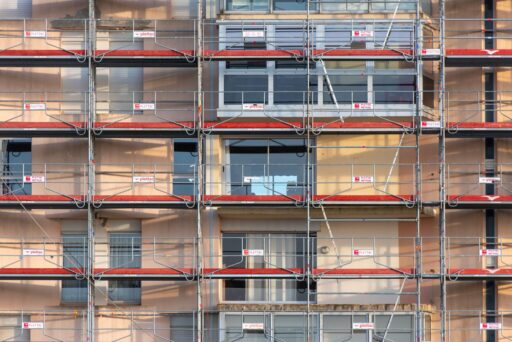
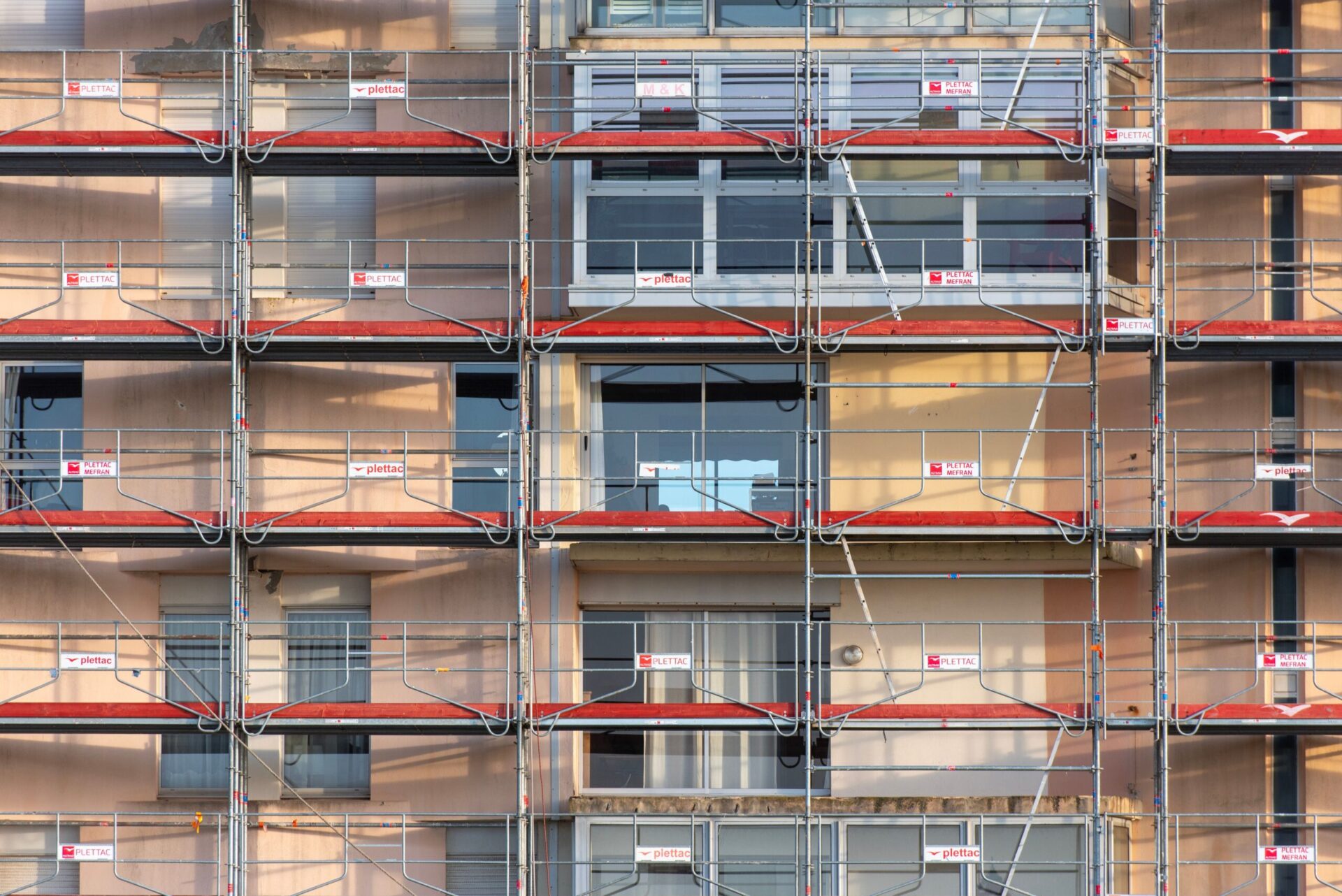
Break a scaffolding quote down line by line and the pattern jumps out:
Fixed costs, independent of the task: design and structural calculations where the structure is non-standard (the EN 12811-1 standard sets the performance requirements for working scaffolds in Europe); transport and mobilisation; erection labour; dismantling labour; installing anchors and then filling the fixing holes.
Duration-related costs: hire charges per period; licences to occupy the public highway or pavement, generally renewed monthly (British guides give around £140 per month, again depending on jurisdiction); statutory inspections at regular intervals and after any event likely to affect stability, which, under the European framework for work at height (Directive 2001/45/EC, transposed into each national law), must be carried out by a competent person and recorded.
Contingent costs: weather delays; security and site protection; repairing damage caused to the facade by the anchors.
For a three-day cleaning task, the fixed and permit-related items weigh so heavily that the cleaning labour itself becomes negligible. That is the hidden cost — not a secret line item, but a structural reality, plainly visible from the first page of the quote.
Facade scaffolding: the costs that never appear on the quote
Liability during work at height. According to Eurostat data, construction accounted for around 23% of all fatal accidents at work in the EU in 2023, and EU-OSHA identifies falls from height as the leading cause of fatal accidents in the sector. This risk has a price — built into the contractor’s insurance, into the client’s obligations under the Construction Sites Directive, and into the administrative burden of method statements and rescue plans. It rarely appears as a separate line, and that is precisely why it is left out of comparisons.
Building security. Scaffolding erected against a facade gives access to windows that were previously out of reach. In the United Kingdom, insurers commonly require notification of works and of scaffolding being erected, and cover may be called into question if it is not declared. Scaffold alarm systems exist as a commercial product category precisely because this risk is real, not theoretical. Whether this cost is yours or the contractor’s depends on the terms of the contract — but someone bears it.
Disruption for occupants and tenants. Sheeted scaffolding reduces natural light in the rooms behind it, clutters balconies and terraces, removes all privacy at window level and takes up parking spaces or pavement. In commercial leases, prolonged obstruction may engage quiet enjoyment clauses or give rise to service charge disputes; whether this gives an enforceable right to a rent reduction depends on the jurisdiction and the lease, and I would treat any general claim on the subject with caution. The more diffuse cost — complaints, management time, relations with the occupants of a residential building — is real and consistently underestimated.
Drone or scaffolding for facade cleaning: the ten-year balance sheet
The table below is a structural comparison, not a price list. Where I have market figures, I say so and flag their reliability; where I do not, I give the cost driver rather than inventing a figure. Scenario: a six-storey residential building in central or northern Europe, with around 2,000 m² of rendered facade and a pitched tiled roof, over a ten-year horizon.
| Cost item | What drives it | Scaffolding + high-pressure cleaning | Aerial chemical application (drone) | Data reliability |
|---|---|---|---|---|
| Access mobilisation | Fixed for each visit, independent of task duration | Dominant item; 4-week minimum hire common | Near zero; set-up measured in hours | Good (trade price guides) |
| Duration-related access cost | Weeks of hire | Charged by the week even for a 3-day task | Not applicable | Good |
| Permits / licences | Occupation of pavement or public highway, monthly | Recurs at each visit; ~£140/month as an indication (UK) | Generally none; airspace authorisation instead | Medium |
| Regulatory burden | Work-at-height obligations vs aviation obligations | Inspections by a competent person, rescue plan | EASA operational authorisation, remote pilot competence, insurance | Good (both frameworks are public) |
| Work-at-height liability | People exposed at height | Full exposure; construction accounts for ~23% of fatal accidents at work in the EU | Exposure shifts towards third-party / overflight risk | Good for the statistic; the shift is a trend, not quantified |
| Water and effluent | Volume used and recovered | High volume; runoff recovery often required | Low volume; runoff remains a regulated issue | Medium |
| Risk of substrate damage | Pressure applied vs material strength | Real and cumulative (see below) | Low mechanical risk; chemical risk remains | Good (conservation guidance) |
| Interval between visits | Speed of recolonisation, which the method itself changes | Shortened by the roughness created on the surface | Longer when the surface stays intact | Good for the mechanism; weak field quantification |
| Visits over 10 years | Interval above | More visits, each with full mobilisation | Fewer visits, each cheap to mobilise | Inferred |
| Disruption for occupants | Duration of obstruction | From a few days to a few weeks per visit | A few hours per visit | Obvious |
The most decisive row is the interval between visits, and yet it is the one almost nobody talks about — because it requires understanding what high-pressure cleaning does to the material.
High-pressure facade cleaning: why the method changes the interval
Biological colonisation of a facade is governed by bioreceptivity: a material’s intrinsic susceptibility to being colonised, a concept formalised by Guillitte in 1995. A standard distinction is drawn between primary bioreceptivity — the potential of a sound, freshly cut surface — and secondary bioreceptivity, that of a surface after weathering or ageing.
The distinction matters, because the two are not equivalent. Work commissioned by Historic England on artificially aged building stones showed that weathered samples supported measurably greater algal colonisation than sound samples, whether limestone, sandstone or granite; the ageing protocol increased open porosity by around 6.7% (sandstone) to 22% (granite), and capillary water absorption by 17% to 52%. The amount of chlorophyll extracted correlated positively with these changes.
In addition, work on the bioreceptivity of cementitious materials identifies a surface roughness of around 20–150 µm as the range that favours microbial adhesion — irregularities slightly larger than the colonising organisms themselves —, alongside surface water retention and surface pH.
Apply this to a pressure washer. Conservation specifications are explicit about the limits: the US federal guidance for historic masonry caps water washing at 300 psi (about 21 bar) and rinsing at 400 psi (about 28 bar), with a minimum distance of 450 mm. A consumer pressure washer, petrol or electric, runs at 100–150 bar — five to seven times that cap. At such pressures, on a cement render, an aged clay tile or lime masonry, you do not just remove the biofilm: you strip off the fired skin or the cement-rich laitance, expose the aggregate, open up the porosity and increase the roughness.
This is a cleaning method that manufactures secondary bioreceptivity. The facade recolonises faster, and each cycle speeds up the next one further. Over ten years, the effect adds up to extra visits, each bearing the full block-based access cost described above — and, eventually, to premature re-cladding of the facade or re-roofing, which is capital expenditure rather than maintenance.
I want to be careful here: the mechanism is well supported, but I have found no controlled longitudinal field study quantifying how many months of interval a given high-pressure cleaning regime actually loses on a given render system. Treat the direction of the effect as solid, and its magnitude as unquantified.
Drone cleaning: what a drone physically can and cannot do
Physics draws a clear line between two very different operations, and it is by confusing them that most analyses go wrong.
Applying chemicals is done at low flow and low pressure, which suits a free-flying aircraft well. The constraint is payload: water weighs 1 kg/litre, so tank volume is paid for directly in endurance, and the work rate depends on refilling and repositioning cycles rather than on spray flow rate.
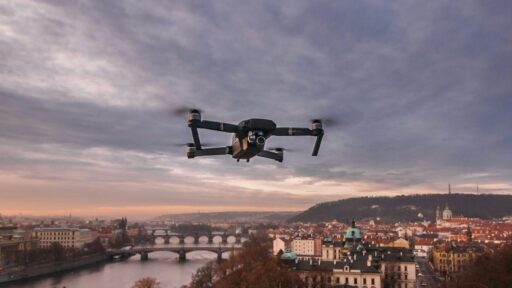
Mechanical washing is an entirely different problem, because a water jet produces a reaction force. It is simple to calculate: jet velocity is approximately √(2ΔP/ρ), and the reaction force equals the mass flow rate multiplied by that velocity. Do the maths and the order of magnitude becomes obvious: about 18 N (1.9 kgf) at 60 bar and 10 L/min, about 24 N (2.4 kgf) at 100 bar and 10 L/min, and nearly 58 N (5.9 kgf) at 150 bar and 20 L/min. For a multirotor of modest mass, a continuous horizontal thrust of several kilograms-force is not a mere trim adjustment: it is a dominant disturbance. Recently published work on water-jet cleaning from a drone addresses precisely this problem, combining an opposing auxiliary propeller with disturbance-aware control to markedly reduce tracking error and keep position error to a few centimetres.
This is why serious high-flow systems are tethered drones: hose and power supply run from pumps and generators on the ground, the aircraft becomes an end effector rather than an autonomous vehicle, and payload stops being the limiting factor. The trade-off is a new set of constraints — the mass and drag of the tether, height and reach limits set by hose length and pump head, and a ground footprint that starts to look a little like the mobilisation you were trying to avoid in the first place.
The honest conclusion is that low-pressure chemical treatment is where aerial application is physically at ease, and high-pressure mechanical cleaning is where it fights against its own operating principle.
Facade renovation: the comparison most articles get wrong
Here is the objection that should be raised more often: scaffolding is rarely put up solely to clean a facade.
It is put up for render repairs, repointing, window replacement, roofing work, thermal upgrading. Cleaning is then added onto access that is already in place, at a marginal cost close to the labour alone. Any comparison that sets the cost of full scaffolding against a drone visit, and charges the entire access cost to cleaning, is comparing a real aerial job with a hypothetical scaffolding job that no competent asset manager would ever order.
For a stand-alone cleaning task, the real field of comparison is narrower: mobile elevating work platforms (MEWPs), rope access, water-fed telescopic poles (effective up to about 20 m, and cheap; for example those from Unger) and aerial application. Scaffolding is the exception, not the benchmark.
Two further limitations, in all honesty. First, aerial work has its own regulatory burden: under the EASA framework, operations near buildings and uninvolved people generally fall outside the Open category and require an operational authorisation based on a risk assessment, with Member States adding their own rules on the aerial dispersal of liquids. That is an administrative cost, not a zero cost. Second, aerial chemical treatment leaves the dead biomass in place, which weathers away over a few weeks, whereas high-pressure cleaning gives an immediate visual result. When what is at stake is a sale, a letting campaign or a handover of works, ‘clean in eight weeks’ may simply not be the product being sought.
Drone facade treatment: when it really pays off
Aerial treatment makes sense over the whole life cycle when the access cost is genuinely stand-alone and would be incurred only for cleaning; when the facade is large, simple and beyond the reach of a pole used safely; when the maintenance philosophy favours light, frequent interventions over heavy, infrequent ones; and when the substrate is one of those that high-pressure cleaning measurably degrades — old renders, external wall insulation (EWI) systems, aged clay or concrete tiles, soft masonry.
It makes little sense when scaffolding or a mobile elevating work platform is already planned for other works; when the surface is within pole reach; when the expected deliverable is an immediate visual result; when the facade is so ornate that treatment coverage becomes hit-and-miss; or when the underlying problem is water management — defective drips, blocked gutters, missing roof overhangs —, in which case any cleaning method merely buys time without solving anything.
For anyone who really wants to model the question, three questions do most of the work. What is the stand-alone access cost, once the works that would happen anyway are taken out? What is the realistic interval between two visits with each method, given what it does to the surface? And what is the residual capital risk — the point at which accumulated surface damage forces re-cladding or replacement rather than another clean?
Answer these three questions and the comparison almost settles itself. Answer only the first — which is what the headline figures invite you to do — and you will make the wrong decision, in a predictable direction.