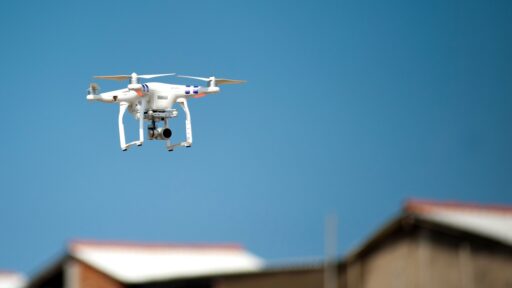

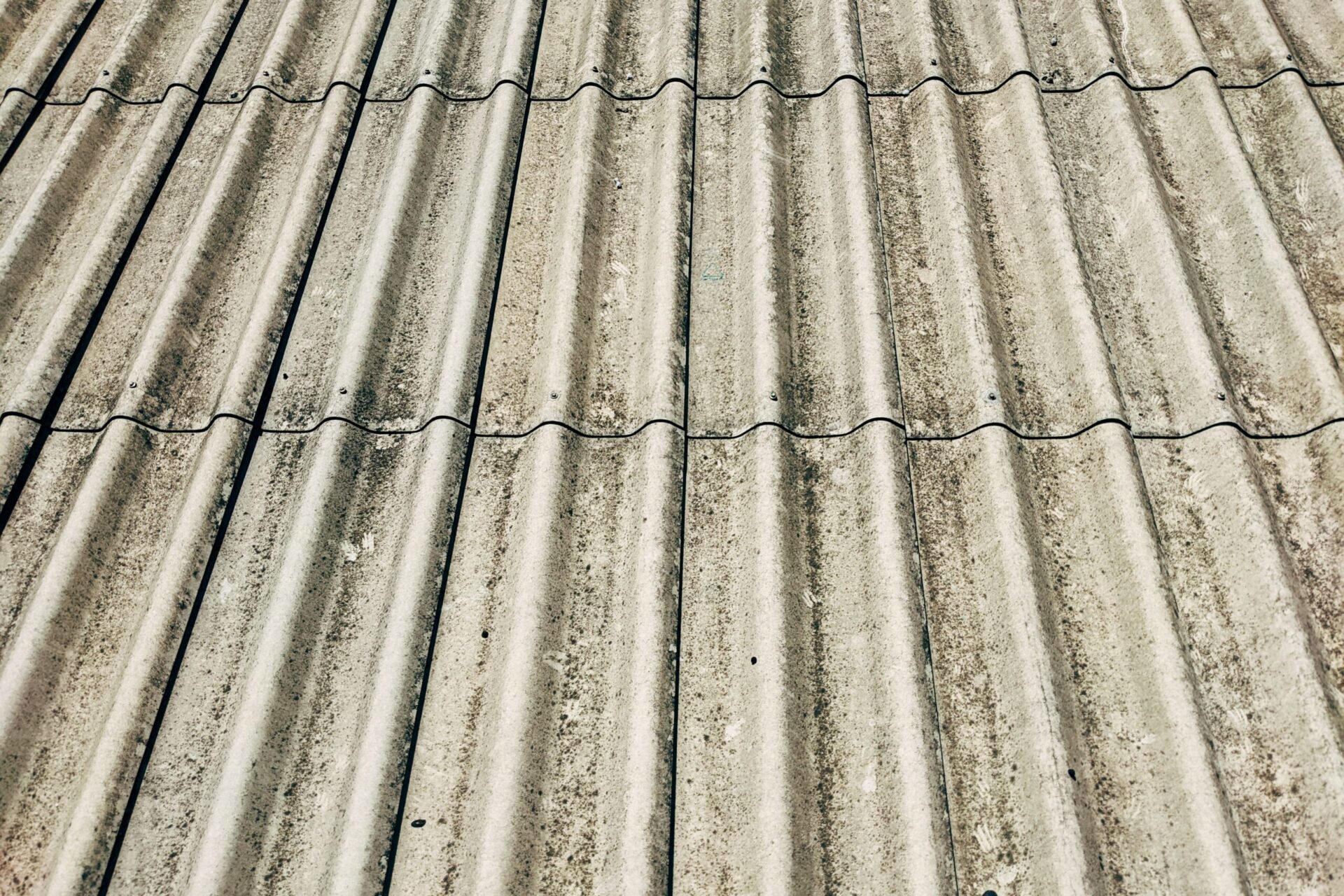
A roof of grey corrugated sheets on a farm shed, artificial slates on a 1980s detached house, fibre cement cladding on an industrial building: these coverings are everywhere in Europe, and many of them become covered in moss and lichens. Their owners regularly receive offers of moss removal by drone, presented as the ideal solution since nobody has to climb onto fragile sheets. This article looks at asbestos roof cleaning by drone: what the drone changes, and what it does not.
That argument is correct, but it only answers half of the problem. The drone removes the risk of falling through the roof, which is very real. It does not remove the risk linked to fibres, which falls under an entirely different legal framework. As long as you do not know whether the roof contains asbestos, the right first step is neither the drone nor the lance, but the survey.
Asbestos cement: why older roofs are affected
For decades, asbestos was added to cement to produce corrugated sheets, slates, ridge pieces, flues and cladding. Mixed with cement in proportions of around 10 to 15%, the fibre reinforced a light, cheap and durable material. Brands such as Eternit became generic names for this type of roofing.
In France, the manufacture, import and placing on the market of asbestos have been banned since 1 January 1997. At European level, Directive 1999/77/EC extended the ban, with a deadline set at 1 January 2005. A fibre cement roof laid before these dates must therefore be regarded as likely to contain asbestos until proven otherwise. Manufacturers replaced asbestos with synthetic or cellulose fibres, but the appearance of the sheets has barely changed: it is impossible to tell by eye.
Asbestos cement is a so-called non-friable material: the fibres are bound in the cement matrix. As long as the sheet is intact, few fibres are released. The problem comes with ageing. Under the effect of slightly acidic rain, freeze cycles and biological colonisation, the surface degrades. Mosses and lichens contribute to this: lichen hyphae and the organic acids they produce attack the cement paste, and moss rhizoids hold water against the sheet. A forty-year-old sheet covered in moss often has a surface where the fibres are exposed.
Cleaning an asbestos roof: what French regulations say
The pre-works survey
The French Labour Code requires the client, that is to say the owner or the maître d’ouvrage (the party commissioning the works), to have the presence of asbestos investigated before any operation likely to expose workers. This is the purpose of Article R4412-97 of the French Labour Code (in French), detailed for built properties by the order of 16 July 2019 (in French) on asbestos surveys before certain operations. This pre-works asbestos survey, often abbreviated to RAT, is carried out by a certified surveyor, and it covers the materials actually affected by the work.
Roof cleaning is indeed an operation likely to disturb the material. There is no exception for ‘small’ jobs or for maintenance work: it is precisely because routine work on asbestos-containing materials exposed tradespeople without their knowledge that this obligation was reinforced. For multi-occupancy buildings, the asbestos technical file (DTA), a file that French building owners must keep on asbestos-containing materials, may already contain useful information, but it does not replace a survey suited to the planned operation where one is required.
Sub-section 3 or sub-section 4: which regime applies?
If the presence of asbestos is confirmed, two regimes coexist in the French Labour Code, known as sub-section 3 and sub-section 4 after the parts of the Code that set them out. Removal or encapsulation of asbestos falls under sub-section 3, reserved for certified companies. Work on asbestos-containing materials that is not intended to remove them, such as upkeep, maintenance or cleaning, falls under sub-section 4. This requires, in particular:
- specific training of workers in asbestos risk prevention,
- a written operating procedure, describing the techniques, the protective measures and waste management,
- an assessment of the expected dust level, and compliance with the occupational exposure limit value, set in France at 10 fibres per litre over eight hours,
- suitable protective equipment, and management of asbestos waste through dedicated channels.
The INRS (in French), France’s national occupational health and safety research institute, sets out these obligations in detail, and publishes resources on the applicable regulations (in French). The European approach points in the same direction: Directive (EU) 2023/2668, which amends Directive 2009/148/EC on the protection of workers, gradually lowers the limit value throughout the Union and requires a switch to more precise counting methods.
One point is often misunderstood: this framework applies to the company carrying out the work, whether the tool is a lance, a brush or a drone. The absence of anyone on the roof does not take the operation outside the scope of sub-section 4. The remote pilot, the ground operator handling the hose and the person collecting the water are all potentially exposed workers.
What water and pressure do to an asbestos cement sheet
Physics explains why the authorities are particularly wary of cleaning.
High pressure wears away the matrix. A jet at 100–150 bar strips off the surface cement paste, which is precisely what holds the fibres. Each pass exposes a new layer. The released fibres do not go into the air in dry form: they are first carried away in the water.
Water moves the problem elsewhere. Runoff water from cleaning an asbestos roof contains fibres. It settles in gutters, in inspection chambers, on the ground and in flower beds. Once the water has evaporated, these deposits can be put back into suspension by wind, lawnmowers or passing vehicles. This is why serious operating procedures provide for filtering or collecting the water, and for cleaning the surrounding area. It is also why managing runoff water is never a detail on this type of job.
Dry brushing is worse. Brushing or scraping a dry sheet releases fibres directly into the air. In France, techniques that generate heavy dust on asbestos cement are tightly regulated, and high-speed rotary or abrasive tools must be avoided.
Chemicals alone reduce the disturbance, without eliminating it. A biocide applied at low pressure, without mechanical action, disturbs the material much less than stripping. But the dead moss and lichens eventually come away in the rain, taking with them part of the surface to which they were anchored. The treatment does not release fibres on the day itself, but it is not neutral over time.
Drone cleaning of an asbestos roof: the real advantages
It would be unfair to see the drone as nothing more than a false argument. On this type of roof, it brings two real benefits.
It removes the risk of falling through the sheets. Aged fibre cement sheets cannot bear a person’s weight. Falls through fragile roofs are among the most recurrent fatal accidents in construction and agriculture, as prevention campaigns on falls from height (in French) point out. Working without anyone on the roof eliminates this risk at source, without walkways or nets under the roof.
It allows contactless, low-pressure application. A spraying drone is physically incapable of stripping a roof at high pressure in free flight: the reaction force of the jet would destabilise the aircraft. It is therefore naturally limited to low-pressure chemical application, which is the least aggressive method for the sheet. For the assessment of the dust level, this is an admissible argument, provided the company can demonstrate it with measurements or reference data.
Drone cleaning: the limits on an asbestos roof
Rotor downwash. A cleaning multirotor blows air downwards at several metres per second. On a dry sheet with a degraded surface, this airflow can in theory put settled dust and fibres back into suspension. To our knowledge, no published data quantifies this phenomenon for drones above asbestos cement. The uncertainty argues for application on a wetted sheet and at a sufficient distance, and for dust measurements during the first jobs.
Drift. Any spraying produces a fraction of fine droplets that drift. On an asbestos roof, these droplets can carry particles towards neighbouring properties. A safety perimeter is required in any case by drone regulations, but here it must take this additional risk into account.
Water collection. This is often the weak point. A drone treats a roof in a few hours, but the water flows into the gutters during the rains of the following weeks, along with the debris of dead moss. The operating procedure must state what happens to this water and debris: temporary blocking of downpipes, filtration, cleaning of valley gutters by trained staff, disposal through the asbestos waste channel.
Waste. The mosses, lichens and deposits recovered from an asbestos roof are waste likely to contain asbestos. They go neither to the compost heap nor to the ordinary household waste recycling centre.
Should an asbestos roof be cleaned?
This is the question that commercial offers rarely ask. An asbestos cement roof thirty or forty years old is often reaching the end of its life: brittle sheets, corroded fixings, uncertain watertightness. Removing the moss can improve its appearance and slow water retention, but it does not extend the life of the roof indefinitely. In many cases, the rational decision consists in comparing:
- supervised cleaning, with a survey, a sub-section 4 operating procedure, water and waste management, whose real cost is markedly higher than that of ordinary moss removal,
- simple monitoring, with no intervention, if the roof is still sound and the colonisation is not causing leaks,
- replacement or encapsulation, which fall under sub-section 3 and certified companies, but which solve the problem for several decades.
The orders of magnitude below use the reference unit from our other articles, one drone cleaning pass on a reference house. They are indicative and depend heavily on the surface area, accessibility and local waste treatment channels.
| Option for an asbestos roof | Indicative cost (× reference unit) | Duration of effect | Key point |
|---|---|---|---|
| Supervised chemical cleaning by drone | 1.5–3× depending on area and water management | A few years | Survey and operating procedure essential |
| Monitoring without intervention | Cost of an inspection | Not applicable | Acceptable if the roof remains watertight |
| Replacement of the roof | Markedly higher, often 15× or more | Several decades | Sub-section 3, certified company |
The documents to ask for before any moss removal
If your fibre cement roof dates from before 1997, ask the company, before placing any order, for:
- The asbestos survey report covering the roof, carried out by a certified surveyor, or documentary proof that the roof post-dates the ban and is asbestos-free.
- The sub-section 4 training certificate of every worker present on site, including those on the ground.
- The operating procedure describing the technique, the pressure, the product, the protection of the surrounding area, water and waste management, and, where required, its submission to the labour inspectorate (the inspection du travail, the French state body that enforces labour law).
- The drone operational authorisation covering this type of flight, and the third-party liability insurance certificate. Check that pollution and contamination are not excluded, a point developed in our article on drone insurance.
- The asbestos waste tracking form at the end of the job.
A company that replies ‘with the drone, we don’t touch the roof, so asbestos isn’t an issue’ has already answered the question. The drone is a good tool for avoiding walking on a fragile roof. It does not turn an asbestos-containing material into an ordinary material.
Asbestos roof: the key takeaways
On a recent, asbestos-free fibre cement roof, drone cleaning is an excellent option: it avoids trampling on fragile sheets and is naturally limited to gentle application. On a roof dating from before 1997, the order of steps is fixed: survey first, decision next, and only after that, choice of method, with a trained company, a written operating procedure and serious management of water and waste. For many asbestos roofs at the end of their life, the honest answer is, moreover, not better cleaning but a replacement plan.