
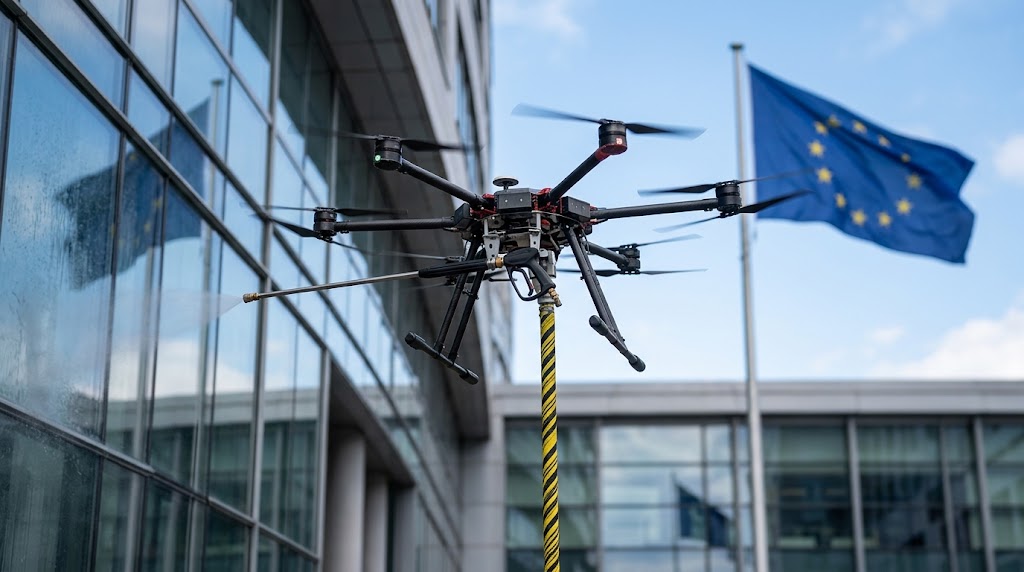
Article 4 of Regulation (EU) 2019/947 sets the conditions for the Open category of drone operations. A single clause settles the whole question, in eleven words: during flight, the unmanned aircraft ‘does not carry dangerous goods and does not drop any material’. Under European drone regulations, a spraying drone cannot be flown in the Open category.
Spraying is dropping material. It does not matter how light the aircraft is, how low it flies or how isolated the site is. Any operation that projects a liquid onto a building falls outside the Open category by definition, in every EASA Member State, with no derogation possible. In other words, every compliant facade or roof treatment flight in Europe falls under the Specific category and relies on an authorisation or a declaration held by an identified operator.
This is a strong, and verifiable, claim about a service sold all over the continent. What is interesting is to see how rarely clients ask to see the document.
Drone regulations: why the category architecture excludes cleaning from the Open category
The European framework classifies operations by their level of risk, not by their purpose. The Open category covers low-risk flights, with no prior authorisation. The Specific category covers everything beyond that, up to the point where the operation resembles conventional aviation: the Certified category then applies. The national civil aviation authorities — the DGAC, France’s civil aviation authority (in French), the LBA in Germany, ENAC in Italy, AESA in Spain — administer one and the same instrument, not parallel regimes.
In the Open category, flights must stay below 120 m, within visual line of sight, with an aircraft of less than 25 kg, and comply with the no-drop clause. Within this category, three subcategories set the distance rules, linked to the class markings carried by the aircraft:
- A1 — C0 and C1 aircraft, which may fly over people, provided that such overflight is kept to a strict minimum.
- A2 — C2 aircraft, which must keep a horizontal distance from uninvolved people at least equal to the flight height (the 1:1 rule), with an absolute minimum of 30 m, reduced to 5 m in low-speed mode.
- A3 — C3 and C4 aircraft, which must stay 150 m from residential, commercial, industrial and recreational areas.
Now let us apply these rules to a building. Even for an inspection flight without a drop of liquid on board, the A3 150 m rule rules out practically all urban facades, and the A2 30 m distance is hard to guarantee in a street with pedestrians. Add the tank, and the no-drop clause closes the door on its own. There are therefore two separate reasons why a cleaning flight cannot fall within the Open category — and a client who is told otherwise is being told something false.
Drone Specific category: what it really requires
There are four routes into the Specific category, and the effort they require varies considerably.
Standard scenarios (STS-01 for visual line of sight flight over a controlled ground area, STS-02 for beyond visual line of sight flight with observers) allow the operator to submit a declaration instead of seeking approval — but only with aircraft bearing the corresponding C5 or C6 class marking, and only if the operation matches the scenario exactly.
Pre-defined risk assessments (PDRA) are templates published by EASA for common types of operation; they lighten the analysis work, but an authorisation is still required.
A full operational authorisation based on the SORA is the general case: the operator carries out a specific operations risk assessment (SORA), and the national civil aviation authority approves a precisely defined operation.
A light UAS operator certificate (LUC) allows an established operator to self-authorise operations within an approved scope, which represents a considerable organisational undertaking.
How the SORA works largely explains why a compliant cleaning operation looks, on the ground, the way it does. The assessment starts from an intrinsic ground risk class, determined by the characteristic dimension and kinetic energy of the aircraft, and by the population density beneath the operational volume. To this operational volume is added a ground risk buffer — the space where the aircraft could plausibly come down after a loss of control, calculated from height and speed.
For facade work, this is the crux of the problem. At 20 m height along a building, the buffer projects outwards, over the pavement and often onto the road. It is the population density within this buffer that sets the risk class, and it is a variable the operator can control: by establishing a safety perimeter, posting ground staff, working outside occupancy hours, sheltering under an adjacent structure. These measures are not a matter of courtesy. They are the mitigations that allow the risk assessment to succeed, and removing them invalidates the authorisation under which the operation is conducted.
This is also why the compliant version of the job is slower and more restrictive than its promotional version. Ground control is an integral part of the aircraft’s safety case.
Drone insurance: where the real risk usually lies
Regulation (EC) No 785/2004 sets minimum third-party liability insurance requirements for aircraft operators, expressed in special drawing rights (SDR) according to maximum take-off mass. The lowest band — aircraft up to 500 kg MTOM, which covers every drone in this sector — requires a minimum of 750,000 SDR. The regulation’s exemption for model aircraft under 20 kg covers sporting and recreational use; commercial UAS operations therefore fall within its scope. The way each Member State has applied this requirement to very small UAS has varied over time: in practice, it is better to read the certificate than to rely on the general rule.
More useful than the stated limit, there is a question almost nobody asks: what does the policy exclude?
Aviation liability covers bodily injury and property damage caused to third parties. Two exclusions are common in the insurance market generally; they are worth checking on each policy, without presuming anything either way:
Property in the insured’s care, custody or control. During the job, the building being treated arguably matches this definition exactly. A policy worded this way would cover a damaged car parked across the street, but not the facade the operator was treating.
Pollution and contamination. Applying chemicals introduces a category of liability for which aviation insurance is not designed: spray drifting onto a neighbouring property, runoff water reaching a watercourse, damage to plants. In the EU, environmental liability is also governed by a separate instrument, Directive 2004/35/EC on environmental liability, which applies to operators of certain professional activities.
I want to be clear: these are points to check, not legal certainties. Policy wordings differ by insurer and by market, and I have not seen any published study measuring how UAS policies in Europe treat either of these exclusions. The observation still stands: the limit written on the certificate tells you far less than the exclusions.
Drone geographical zones: the part of the system that really does not work
Article 15 of Regulation 2019/947 allows Member States to define UAS geographical zones — areas where flight is prohibited, restricted or subject to conditions. Heritage sites, protected habitats, prisons, ports, industrial installations and the surroundings of aerodromes are among the classic designations, and they are set at national level (for France, see for example the Géoportail map of UAS restrictions (in French)).
The framework assumed that these zones would be published in a common, machine-readable format, so that operators — and on-board geo-awareness systems — could use them consistently. A study covering 30 European countries, published in September 2026, first found that only 11 of them published zone data in the agreed format, with rights of use; its update of 21 September 2026 lowers this to 7 countries publishing a file with a licence to use it, while 3 others publish it with restricted use and 6 publish it without stating any terms. The practical consequence, in the study’s own terms: conscientious operators end up relying on commercial aggregator apps of uncertain provenance, or checking nothing at all.
‘We checked the drone map’ is therefore a weaker guarantee than it seems, and for any site subject to protection, the check should go all the way back to the national civil aviation authority rather than stop at an app. This is a genuine gap in an otherwise fairly coherent framework, and it is worth knowing about precisely because it is invisible from the outside.
Biocides and drone facade cleaning: the question almost everyone gets backwards
One confusion is worth clearing up: the European ban on aerial spraying, laid down in Article 9 of Directive 2009/128/EC establishing a framework for Community action to achieve the sustainable use of pesticides, applies to plant protection products. Drones are considered a form of aerial spraying under it, and the derogations are narrow. A Commission proposal of December 2025 (COM(2025) 1021) would introduce a mechanism allowing certain types of drone to be exempted, but it nonetheless remains a proposal.
Facade and roof biocides are not plant protection products. They are regulated as biocidal products by Regulation (EU) No 528/2012, a separate regime. The ban on agricultural aerial spraying therefore does not directly govern building cleaning — exactly the opposite of what is often assumed, in one direction or the other.
That does not mean, however, that the application method escapes all rules. A biocidal product’s authorisation specifies its authorised uses and conditions of use, including the application method. A product authorised for low-pressure spray or brush application by an operator on the ground is not automatically authorised for aerial dispersal. I have not found a clear, harmonised answer to the question of whether aerial application constitutes a separate authorised use under the Biocidal Products Regulation (BPR), nor on how consistently national competent authorities treat it, and I would be wary of anyone claiming to answer it with confidence. The verifiable question for a client is narrower, and it has an answer: what is the authorisation number, and does the authorised use cover the proposed method?
Drone roof cleaning: what these checks do not tell you
A balanced article must acknowledge the limits of the exercise.
Regulatory compliance is a minimum foundation for aviation safety and public safety. It says nothing about the operator’s understanding of facade materials. An operation can have an impeccable operational authorisation, adequate insurance, a correctly declared standard scenario and a qualified remote pilot, and still apply the wrong product to a lime-based substrate, in the wrong season and at the wrong dose. Aviation documents and building expertise are two independent dimensions, and confusing them is a pitfall in its own right.
There is also a problem of proportionality. The documentary burden falls mainly on small operators, and a client who demands documents they are unable to assess gets a performance rather than a guarantee. Asking for an authorisation reference is useful; asking for a full SORA file that you will not read is not.
Finally, the client is not a mere spectator. Under national transpositions of the European directives on construction sites and work equipment, the owner of a building or the coordinator they have appointed commonly bears planning and coordination obligations for work carried out on their property, whatever the contractor’s aviation file says. These obligations are not transferred with the flight.
Drone cleaning: what really needs checking
Six questions, which any operator who is genuinely compliant can answer in one sentence:
- The operator’s registration number and State of registration. At EU level, it is operators that are registered, not aircraft (in France, drones of 800 g or more must also be registered by their owner on the AlphaTango portal); the number must appear on the airframe.
- The route that authorises this work — a declaration under a standard scenario (and in that case, does the aircraft bear the required C5 or C6 class marking?), a PDRA or an operational authorisation. Ask for the document, and read its scope and expiry date rather than settling for the fact that it exists.
- Remote pilot competencies suited to that route, not a generic certificate obtained online for flying in the Open category.
- The insurance certificate, and more specifically whether it covers damage to the property being treated as well as pollution or contamination.
- The product’s BPR authorisation number, and whether the authorised use covers the proposed application method.
- The ground risk management plan — what happens to the pavement, parking, the entrance and the occupants during the flight, since this is part of the safety case and not a mere convenience.
If the site is subject to heritage protection, or hosts a protected habitat or a bat or bird roost, add the corresponding authorisation and survey to the list, because they fall under separate legal procedures, with their own timescales.
What is really instructive about this list is not the content of the answers. It is whether or not they arrive. An operator working within the Specific category has these documents to hand, because the regulatory framework requires it. These questions cost nothing, and the time taken to answer a simple request for an authorisation reference is one of the few means of vigilance available to a client who cannot assess the flying themselves.
Sources
- Commission Implementing Regulation (EU) 2019/947 — rules and procedures for the operation of unmanned aircraft (EUR-Lex)
- Article 4 — Open category of UAS operations (regulatory text, including the no-drop clause)
- Article 15 — Operational conditions for UAS geographical zones
- EASA — Flying drones close to people (A1/A2/A3 distance rules)
- EASA — Specific category: STS, PDRA, SORA and LUC
- EASA — Specific Operations Risk Assessment (SORA)
- Regulation (EC) No 785/2004 — insurance requirements for air carriers and aircraft operators (EUR-Lex)
- Unmanned Airspace — study showing that only 11 of 30 European countries publish UAS geographical zone data in the agreed format (September 2026)
- ICAERUS — Drone spraying in Europe: current legislative framework and the way forward
- COM(2025) 1021 — ‘Food and Feed Safety Omnibus’ proposal (draft Article 9a on drone exemptions)
- Directive 2004/35/EC — environmental liability